
How to Size a Processing Line to Match Your Annual Volume
How to work out the capacity your line needs: the basic formula, annual tonnage for every Albion line, worked examples and what we need to quote.
“What model do I need if I process this many tons a year?” We hear it often, especially from people who want to start without falling short, and the answer takes the same shape for all ten products that Albion lines process: raisins, prunes, walnuts, almonds, hazelnuts, dried tomatoes, carrots, garlic, onions and potatoes. The math is simple; what changes from one plant to the next are the factors that go into it.
Two things work in your favor: the capacities we publish are conservative (with good raw material and under normal conditions, each line is built to reach its nominal number), and many lines can be expanded later, so you don’t need to buy today the capacity you’ll need in five years.
Here you’ll find the method, every line’s capacity in tons per year, three examples and the information we need to size your line.
The basic formula
Annual volume = hourly capacity × hours per day × days per year
Turned around, it tells you the capacity you need:
Required hourly capacity = annual volume ÷ (hours per day × days per year)
Before you look at models, check the factors that move the result most.
Season length
Many products aren’t processed year-round but in a window after harvest. With raisins in Argentina, for example, harvest is concentrated in March and April, and processing typically runs from May through September. Count the actual days in that window, not the working days in the year.
Shifts
Hours per day depend on how many shifts your crew can sustain: add a shift and the same line processes more volume in the same season.
Peaks vs. average
The formula gives you an average, but raw material doesn’t arrive evenly. If some weeks bring in far more than others and the product can’t wait, the line has to handle the peak, not just the average. Within the line, some models also include a buffer that keeps the flow steady, such as the receiving vat on the AV 10000 or the accumulation disc on the ZC 8000, which absorbs flow peaks ahead of sizing.
Room to grow
If you expect more volume in coming seasons, you can buy tomorrow’s capacity today or choose a family that scales. The families that allow it are listed below.
Watch the unit
On several lines, capacity is measured on what goes into the line: for the AP and ALP lines it’s calibrated in-shell walnut or almond; for the M, walnut with husk; for the TO lines, fresh tomato, not finished dried tomato. Compare your volume in the same unit.
Capacity and annual tonnage for every line
To compare models, we use the same assumption as our product guides: standard operation of 8 hours a day × 200 days a year = 1,600 hours. The tonnage in the tables is the published capacity multiplied by those 1,600 hours: indicative figures, not a production commitment. When capacity is a range, so is the result. Some models with the same capacity share a row.
Dried fruit: raisins and prunes
| Product | Process | Model | Capacity | Indicative metric tons per year |
|---|---|---|---|---|
| Raisins | Washing / destemming | PUA 300 L, PUA 300 D | 250–300 kg/h | 400–480 |
| Raisins | Washing / destemming | PUB 600 L, PUB 600 D | 550–600 kg/h | 880–960 |
| Raisins | Washing / destemming | PUA 2000 L, PUB 2000 D | 1,800–1,900 kg/h | 2,880–3,040 |
| Raisins | Destemming | PUA 5000 D | 3,000–3,500 kg/h | 4,800–5,600 |
| Prunes | Sizing | CA 1000 7T, CA-E 1000 | 700–800 kg/h | 1,120–1,280 |
| Prunes | Pitting | CD 4 | 1,100 kg/h | 1,760 |
| Prunes | Sizing | CA 1200, CD 1200, CF 1200 | 1,200–1,400 kg/h | 1,920–2,240 |
| Prunes | Sizing | CE 1200, CE-E 1200 | 1,500–1,700 kg/h | 2,400–2,720 |
| Prunes | Pitting | CD 6 | 1,600 kg/h | 2,560 |
| Prunes | Pitting | CD 8 | 2,200 kg/h | 3,520 |
| Prunes | Sizing | CD 1500, CF 1500 | 2,500–2,700 kg/h | 4,000–4,320 |
| Prunes | Sizing | CE 1500, CE-E 1500 | 2,800–3,000 kg/h | 4,480–4,800 |
| Prunes | Sizing | CF 1800 | 3,300–3,500 kg/h | 5,280–5,600 |
| Prunes | Sizing | CE 1800, CE-E 1800 | 3,500–3,800 kg/h | 5,600–6,080 |
In raisins, the L lines wash and the D lines destem. In prunes, the CD 1200 and CD 1500 size the fruit, while the CD 4, CD 6 and CD 8 pit it.
Nuts: walnuts, almonds and hazelnuts
| Product | Process | Model | Capacity | Indicative metric tons per year |
|---|---|---|---|---|
| Walnuts | Dehulling, washing and drying | M | 2,000–2,500 kg/h (walnut with husk) | 3,200–4,000 |
| Walnuts | Sizing | CR 800 5T | 450 kg/h | 720 |
| Walnuts | Sizing | CR 800 6T | 600 kg/h | 960 |
| Walnuts | Sizing | CR 1000 5T, CR 1000 6T, CR 1000 6T BC | 900–1,000 kg/h | 1,440–1,600 |
| Walnuts | Sizing | CR VC 2000 6T | 1,800–1,900 kg/h | 2,880–3,040 |
| Walnuts | Cracking and selection | AP 300 | 300–350 kg/h (calibrated in-shell walnut) | 480–560 |
| Walnuts | Cracking and selection | AP 700, AP 700 without bin tipper | 600–650 kg/h (calibrated in-shell walnut) | 960–1,040 |
| Walnuts | Manual kernel selection | ASM 700 | 600 kg/h | 960 |
| Almonds | Cracking and selection | ALP 300 | 300–350 kg/h (calibrated in-shell almond) | 480–560 |
| Almonds | Cracking and selection | ALP 700 | 600–650 kg/h (calibrated in-shell almond) | 960–1,040 |
| Hazelnuts | Reception and processing | AV 10000 | 8,000–10,000 kg/h | 12,800–16,000 |
Where the capacity names the product in parentheses, the tons refer to that same incoming product.
Tomatoes and vegetables
| Product | Process | Model | Capacity | Indicative metric tons per year |
|---|---|---|---|---|
| Dried tomatoes | Cutting and packing | TO C 2800, TO B 2800 | 2,500–2,800 kg/h | 4,000–4,480 |
| Carrots | Washing, sizing and packing | ZC 8000 | 6,000–8,000 kg/h | 9,600–12,800 |
| Carrots | Sizing | ZCR | to be defined per customer integration | — |
| Garlic | Sizing | T 900 CMZVC | 2,000–2,500 kg/h | 3,200–4,000 |
| Garlic | Sizing | T 1200 CMZV 7T, T 1200 CMZIV 7T | 3,500–4,000 kg/h | 5,600–6,400 |
| Onions | Brushing and sizing | LCC 6000 6T | 3,000 kg/h | 4,800 |
| Potatoes | Brushing, sizing and packing | PC 4000 | 4,000 kg/h | 6,400 |
TO line capacity is fresh tomato. The ZCR has no fixed capacity: it’s defined by how it integrates into your plant.
Three hypothetical examples
The volumes in these examples are assumptions made to show the math; the capacities are the published ones.
Example 1: cracking 700 tons of walnuts
A plant needs to crack 700 metric tons of calibrated in-shell walnut per season. At 1,600 hours: 700,000 kg ÷ 1,600 h = 437.5 kg/h on average.
- An AP 300 (300–350 kg/h) would need roughly 2,000 to 2,330 hours: more than the 1,600 assumed.
- An AP 700 (600–650 kg/h) handles it in roughly 1,080 to 1,170 hours, with headroom for peaks.
Example 2: sizing 5,000 tons of garlic
At 1,600 hours: 5,000,000 kg ÷ 1,600 h = 3,125 kg/h on average.
- The T 900 CMZVC (2,000–2,500 kg/h) would need 2,000 to 2,500 hours: not enough.
- A T 1200 (3,500–4,000 kg/h) handles it in roughly 1,250 to 1,430 hours. Between the two T 1200 lines, the product decides, not the volume: if your garlic arrives pre-selected, the T 1200 CMZV 7T; if you need manual inspection for export, the T 1200 CMZIV 7T.
Example 3: destemming 400 tons of raisins in a short season
At 1,600 hours: 400,000 kg ÷ 1,600 h = 250 kg/h on average, right at the low end of the PUA 300 D (250–300 kg/h): it fits, but with no margin.
If those raisins have to be done in 100 eight-hour days (800 hours), the average climbs to 500 kg/h. Then the choice is the PUB 600 D (550–600 kg/h), which handles it in roughly 670 to 730 hours.
One size up, or two lines?
When to go one size up
- Short season. If you have to process everything in a few weeks, a larger model is the better fit: the same volume in half the days calls for twice the hourly capacity, as in Example 3.
- Average at the edge of a range. If your number lands at the low end of a model’s range, there’s little margin left for peaks and stoppages.
- Planned growth. Before oversizing, check whether the family scales. The PUA 300 D can migrate to the PUB 600 D or PUB 2000 D while preserving the investment, and on the washing side the PUA 300 L and PUB 600 L scale up to the PUA 2000 L while preserving your civil works. The CA 1200 is the natural upgrade from the CA 1000 7T, which also shares a technical family with the CD, CE and CF lines: as volume grows, components are interchangeable. The T 1200 CMZV 7T is the natural upgrade from the T 900 CMZVC. And on the M, the ovens are modular: you start with the modules your volume needs and add more without replacing the line.
One large line or two smaller ones in parallel
According to the AP 700 line page, a single 650 kg/h line replaces two AP 300 units in parallel, saving footprint and labor; the ALP 700 page says the same against two ALP 300 units, and the CR VC 2000 6T page against two CR 1000 6T units.
Separate lines make sense when they handle different stages. In raisins, destemming and washing are two lines; in prunes, so are sizing and pitting, and each one is sized for its own volume. In walnuts, the AP 700 is designed to integrate with the CR 1000 6T or the CR VC 2000 6T, keeping the flow between sizing and cracking balanced.
If your volume falls outside the tables
The AV 10000 architecture can be scaled down for smaller volumes as a custom project. In raisins, above the PUB 2000 D, destemming is handled by the PUA 5000 D; for washing, contact us.
What we need to size your line
The quote form asks for a project description covering the product to process, calibration, estimated volume and timing. The more detail you give, the more accurate the proposal. To size your line, it helps to know:
- Product and incoming condition: what you process and how it arrives at your plant (in clusters, with husk, in-shell, in bulk or in bins).
- Calibration: how many size grades your buyers ask for.
- Estimated volume per season, with your actual hours per day and working days.
- Timing: when you need the line up and running.
- Your plant: target market, space in your building, and available electrical power and water.
Write to us through our contact page or use the Request a Quote button on any line page.
Product pages and guides
Each product has a page with its lines and a guide covering the process stages and its own volume math:
Frequently asked questions
- How do I work out the hourly capacity my line needs?
- Divide your annual volume by the hours the line will run in a year: hours per day × days in your season. Using a standard operation of 8 hours × 200 days (1,600 hours), 800 metric tons comes to 500 kg/h on average. It's an indicative calculation, so run it with your plant's actual days and shifts.
- Why do the tables use 1,600 hours a year?
- It's the standard-operation assumption used across Albion's guides: 8 hours a day for 200 days. It gives every model a common basis for comparison, but it doesn't describe your plant. If your season is shorter or you run more shifts, the result changes in the same proportion.
- Should I choose a larger model if my season is short?
- Yes. If you have to process your whole volume in a few weeks, a larger model is the better fit: the same volume in half the days calls for twice the hourly capacity. For example, 400 metric tons of raisins over 1,600 hours is 250 kg/h, but over 800 hours it's 500 kg/h, which is PUB 600 D territory.
- Is one large line better than two smaller ones in parallel?
- According to their line pages, one AP 700 replaces two AP 300 units in parallel and one ALP 700 replaces two ALP 300 units, saving footprint and labor; the CR VC 2000 6T does the same against two CR 1000 6T units. Separate lines make sense when they handle different stages, such as raisin destemming and washing, or prune sizing and pitting. In that case, each line is sized for its own volume.
- Can I start with a smaller model and grow later?
- In several families, yes. The PUA 300 D can migrate to the PUB 600 D or PUB 2000 D while preserving the investment, the CA 1200 is the natural upgrade from the CA 1000 7T, and the T 1200 CMZV 7T is the natural upgrade from the T 900 CMZVC. On the walnut line M, the ovens are modular: you start with the modules your volume needs and add more without replacing the line.
- What information should I send to get my line sized?
- The product you'll process and how it arrives at your plant, the size grades your buyers ask for, your estimated volume per season with your working hours and days, and when you need the line. Your target market, the space available in your building and your available electrical power and water also help. You can send it through the contact page or the Request a Quote button on any line page.
- What if my volume is below the smallest line?
- Tell us about your case. The AV 10000 hazelnut line architecture can be scaled down for smaller volumes as a custom project, and the capacity of the ZCR carrot sizer is defined by how it integrates into your plant. Albion also builds individual equipment to complete an existing plant.
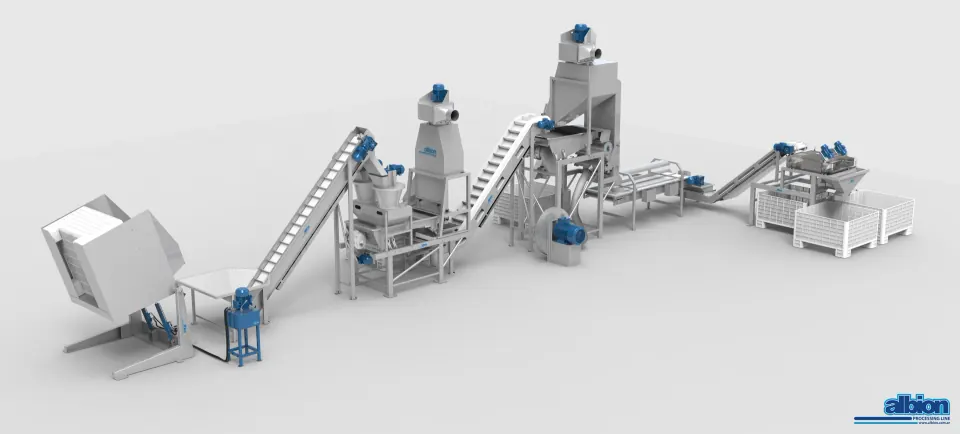
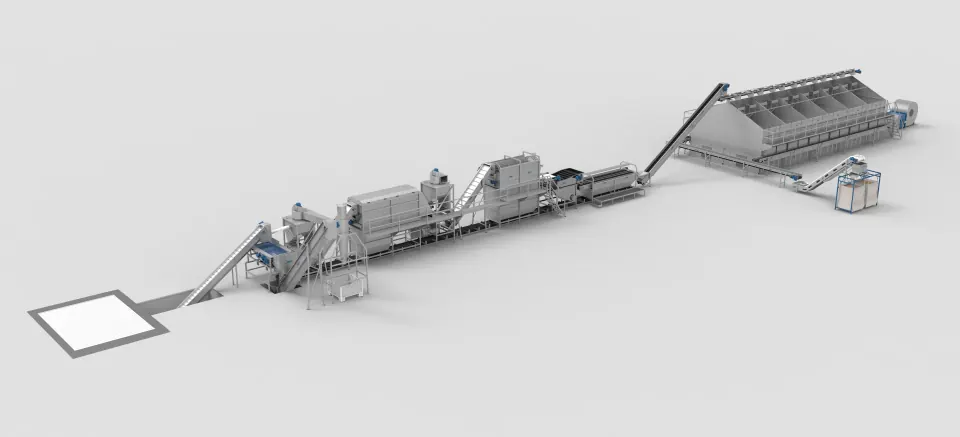
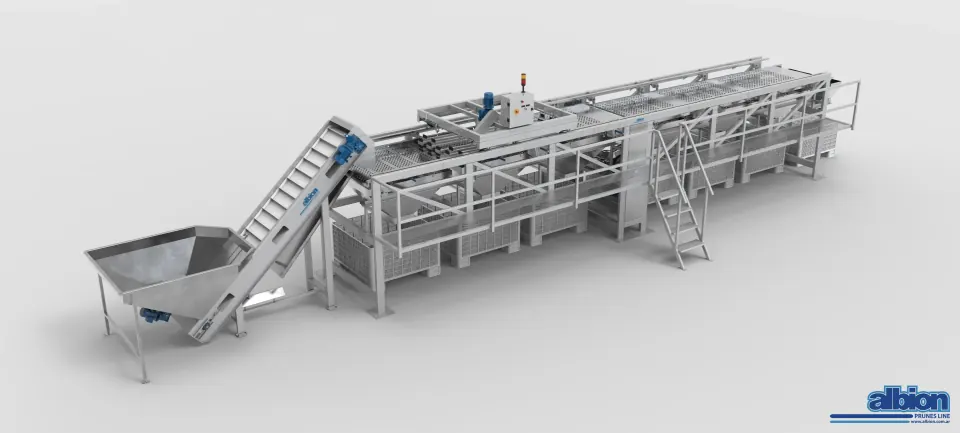
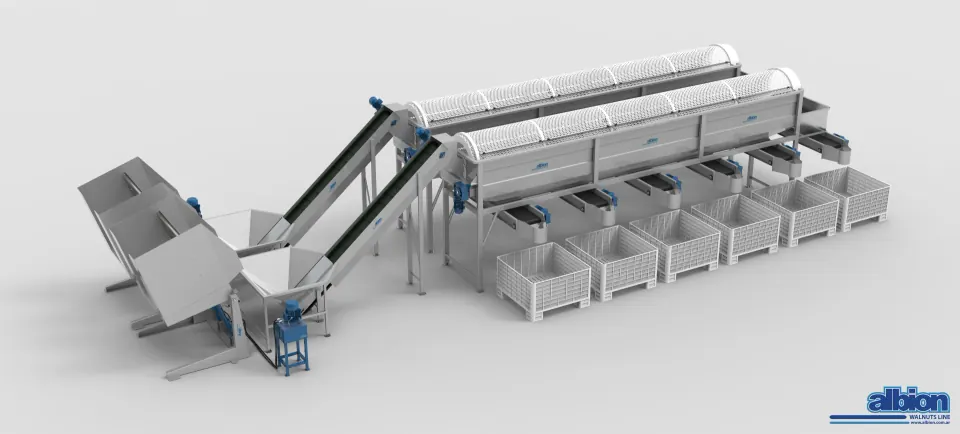
Lines mentioned in this article
Ready to size your processing line?
Send us your operation's basic data and we'll prepare a proposal sized to your volume and your warehouse.
Request a quote