
How to Choose a Hazelnut Processing Line: A Technical Guide
A guide to choosing a hazelnut reception and processing line: process stages, the 8,000–10,000 kg/h AV 10000 and how to size it.
Hazelnuts come in from the field with branches, leaves, stones and soil. Before you can think about packing, they have to go through several successive cleaning stages: removing plant matter, getting rid of stones and soil, washing and visual sorting. When those stages are chained together in a single line, hazelnuts go in at one end and come out clean at the other, in continuous flow.
This guide is for cooperatives, packers and growers evaluating whether to mechanize hazelnut reception and processing: what each stage does, what Albion’s AV 10000 line includes, how to run an orientative capacity calculation, and what to look for in warranty, assembly and financing.
Why mechanize reception and cleaning?
- Continuous flow from unloading. A receiving vat with buffer capacity takes the truck or the bins and feeds the line without interruption.
- Consistent results. A vibrating sieve, a trommel or a flotation washer always does the same job, batch after batch.
- Redundant cleaning. Each stage catches what the previous one didn’t: what slips past the sieve is picked up by the aspirator, and soil stuck to the hazelnut comes off in the wash.
- Organized inspection. Operators perform visual control on elevated catwalks with railings and a sanitary platform, and whatever they reject leaves the line through its own circuit.
The process stages, step by step
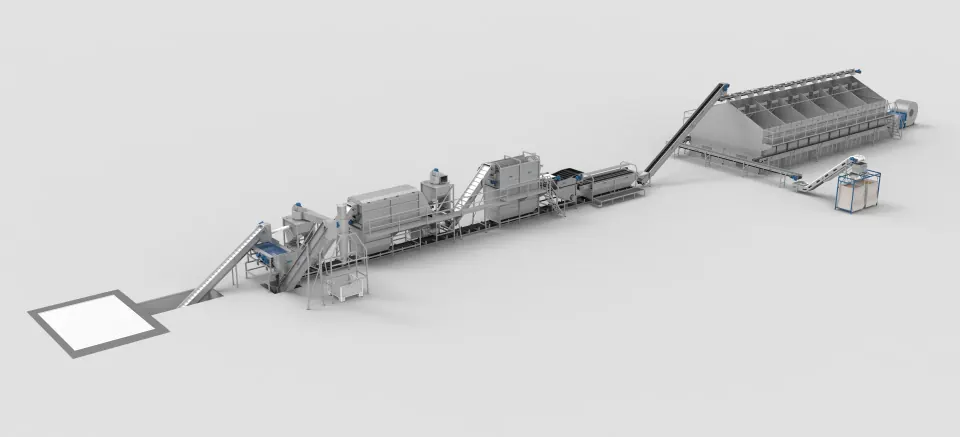
The AV 10000 integrates 13 machines. Grouped by function, this is the path the hazelnut follows.
1. Reception and dosing
- Receiving Vat: accepts direct field discharge, by truck or in bins, and acts as a buffer to keep the flow continuous.
- Vat Elevator: doses the hazelnuts toward the first mechanical-cleaning step.
2. Dry cleaning
- Debrancher: a vibrating sieve that separates large branches, stalks and coarse plant matter.
- Aspirator: a vacuum aspirator that removes leaves, fine dust and light particles the sieve didn’t retain.
3. Stone and soil removal
- Elevator to Trommel: lifts the pre-cleaned hazelnuts up to the rotary separator.
- Trommel: a perforated rotary cylinder that performs a coarse size classification before washing and removes stones and soil clumps.
4. Double washing
- Elevator to Rotary Washer: takes the hazelnuts to the first wash cycle.
- Rotary Washer: a drum with a water curtain that removes adhered soil.
- Flotation Washer: a tank with controlled flotation; sound hazelnuts float and dense impurities settle.
5. Visual inspection and rejects
- Inspection Conveyor with Platforms: visual control by operators on elevated catwalks.
- Reject Collection Conveyor: collects what is rejected during inspection and routes it to the waste circuit.
- Waste Elevator: lifts the rejected material for dispatch outside the line.
6. Final cleaning
- Cyclonic Separator: the last cleaning stage, by cyclonic separation, before the line’s output.
What the AV 10000 includes and who it’s for
The AV 10000 processes 8,000–10,000 kg/h and is the highest-capacity line in the Albion catalog. It’s designed for cooperatives and high-volume packers that receive hazelnuts straight from the field and need them clean and sorted before packing.
Construction and sanitary philosophy:
- Frames and structures in SAE 1010 mild steel, with an anticorrosive primer and polyurethane enamel finish.
- All product-contact surfaces in AISI 304 stainless steel with a sanitary polish, resistant to daily sanitary washing.
- Drives with oil-bath gearmotors and fully shielded three-phase motors.
What if your volume is smaller? The AV 10000 architecture can be scaled down for smaller volumes as a custom-design project. Tell us how much you process and we’ll work it out together.
How to size it: an orientative example
The basic calculation is simple:
Annual capacity = hourly capacity × hours per day × days per year
Assuming standard operation of 8 hours a day × 200 days a year (1,600 hours), the AV 10000 works out like this:
| Period | At 8,000 kg/h | At 10,000 kg/h |
|---|---|---|
| Per hour | 8 t | 10 t |
| Per 8-hour shift | 64 t | 80 t |
| Per year (1,600 hours) | 12,800 t | 16,000 t |
The calculation also works in reverse: if you need to receive 1,000 tons in a season, at 8,000–10,000 kg/h that’s between 100 and 125 hours of line time, roughly 13 to 16 eight-hour shifts.
Important: these figures are orientative and come from the published capacity with the assumptions stated above. If your season is shorter, adjust the hours and days to your actual period. We do the final sizing with your operation’s data.
Equipment you can add
Our individual equipment catalog includes machines sold as standalone units. If you’d like to add one to your hazelnut plant, check with us first whether it fits your case:
- VB 500 Bin Tipper: a hydraulic bin tipper for line start, with an independent hydraulic power unit. It tips product without impact or free fall.
- PES 25 Weigher Bagger: a programmable electronic weigher-bagger for 10 to 25 kg sacks of nuts.
- Elevators and an inspection conveyor as standalone units.
Warranty, assembly, financing and support
- 12-month warranty on mechanical parts of our own manufacture. It does not cover consumables or damage caused by improper maintenance.
- Pre-assembly in our workshop: the line is pre-assembled and concatenated in our workshop before dispatch and arrives ready to assemble on-site.
- Financing: many customers finance their investment through Banco Nación credit lines for domestic industrial machinery. You handle the application with the bank; Albion issues the necessary documentation.
- Support: after-sales technical support is concentrated in Latin America, but we ship equipment worldwide. Albion equipment is operating today in 18 countries on 6 continents.
Behind every line is a family company from Mendoza, founded in 1966 by Atilio César Dal Pozzo, now led by the second generation, with more than 50 in-house experts.
Next step
To move forward:
- Send us your operation’s data: estimated volume per season, how the hazelnuts arrive (truck or bins), available plant space and services (power and water).
- Get a proposal sized to your case: the full AV 10000 or a scaled-down custom architecture.
- Review financing through Banco Nación credit lines, if applicable.
See photos and each machine on the AV 10000 line page, visit our hazelnuts page, or contact us to start your quotation.
Frequently asked questions
- What stages does the AV 10000 hazelnut line include?
- It has 13 integrated machines covering reception, dry cleaning, stone and soil removal, double washing, visual inspection and a final cleaning stage. The flow starts at the receiving vat and continues through the debrancher, aspirator, trommel, rotary washer, flotation washer, inspection conveyor with platforms and cyclonic separator, plus the elevators and the reject circuit. Hazelnuts leave the line clean and sorted, ready to move on to packing.
- What is the line's capacity, and how much can it process per year?
- The AV 10000 processes 8,000–10,000 kg/h and is the highest-capacity line in the Albion catalog. As an orientative reference, running 8 hours a day for 200 days a year works out to 12,800 to 16,000 tons per year. The final figure depends on the actual hours and days of your season.
- Does it work if I process smaller volumes?
- The AV 10000 is designed for cooperatives and high-volume packers. Its architecture can be scaled down for smaller volumes as a custom-design project. Send us your estimated volume and we'll work out the right configuration for your plant.
- What is the line built from?
- All product-contact surfaces are AISI 304 stainless steel with a sanitary polish, resistant to daily sanitary washing. Frames and structures are SAE 1010 mild steel with an anticorrosive primer and polyurethane enamel finish. Drives use oil-bath gearmotors and fully shielded three-phase motors.
- What does the warranty cover, and how does the line arrive at my plant?
- Mechanical parts of our own manufacture carry a 12-month warranty; it does not cover consumables or damage caused by improper maintenance. The line is pre-assembled and concatenated in our workshop before dispatch, and it arrives ready to assemble on-site.
- How can I finance it, and what support is available outside Argentina?
- Many customers finance their investment through Banco Nación credit lines for domestic industrial machinery: you handle the application with the bank, and Albion issues the necessary documentation. After-sales technical support is concentrated in Latin America, but we ship equipment worldwide. Albion equipment is operating today in 18 countries on 6 continents.
Lines mentioned in this article
Ready to size your processing line for hazelnuts?
Send us your operation's basic data and we'll prepare a proposal sized to your volume and your warehouse.
Request a quote