
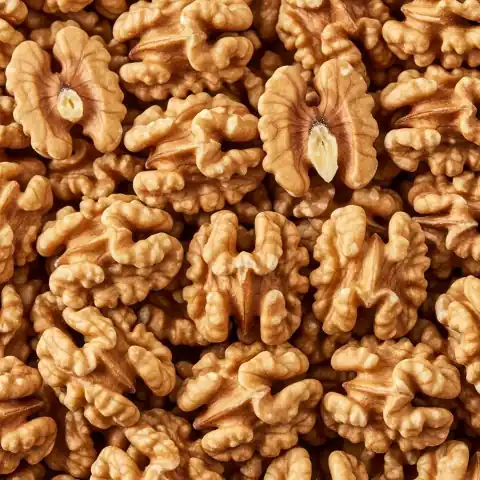
Walnuts Processing Lines
From husk to graded kernel, in four stages.
Stage 1 of 4
Dehulling, washing and drying
Walnuts come in from the field in their husk: the line washes, dehulls and oven-dries them, then fills big bags.
| Model | Capacity | What sets it apart | Actions |
|---|---|---|---|
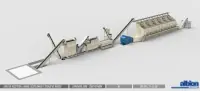 M | 2,000–2,500 kg/hwalnut with husk | Pre-cleans, washes, dehulls, dries in modular ovens and fills big bags | View Line M Get a quote M |
Stage 2 of 4
Sizing
Grades in-shell walnuts by size in a perforated rotary cylinder, into 5 or 6 sizes, to sell them as they are or get them ready for cracking.
| Model | Capacity | What sets it apart | Actions |
|---|---|---|---|
 CR 800 5T | 450 kg/h | 800 mm cylinder · 5 sizes · side outlets to bags | View Line CR 800 5T Get a quote CR 800 5T |
 CR 800 6T | 600 kg/h | 800 mm cylinder · 6 sizes · side outlets to bags | View Line CR 800 6T Get a quote CR 800 6T |
 CR 1000 5T | 900–1,000 kg/h | 950 mm cylinder · 5 sizes · side outlets to bags | View Line CR 1000 5T Get a quote CR 1000 5T |
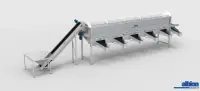 CR 1000 6T | 900–1,000 kg/h | 950 mm cylinder · 6 sizes · side outlets to bags | View Line CR 1000 6T Get a quote CR 1000 6T |
 CR 1000 6T BC | 900–1,000 kg/h | 950 mm cylinder · 6 sizes · central discharge to bins | View Line CR 1000 6T BC Get a quote CR 1000 6T BC |
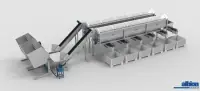 CR VC 2000 6T | 1,800–1,900 kg/h | Several 1,000 mm cylinders in parallel · 6 sizes · to bags or bins | View Line CR VC 2000 6T Get a quote CR VC 2000 6T |
Stage 3 of 4
Cracking and selection
Cracks sized in-shell walnuts with adjustable cones, separates the shell with screens and aspiration, and grades the kernels by size.
| Model | Capacity | What sets it apart | Actions |
|---|---|---|---|
 AP 300 | 300–350 kg/hcalibrated in-shell walnut | One cone cracker · starts at an elevator | View Line AP 300 Get a quote AP 300 |
 AP 700 | 600–650 kg/hcalibrated in-shell walnut | Parallel crackers · starts at a bin tipper | View Line AP 700 Get a quote AP 700 |
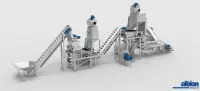 AP 700 without bin tipper | 600–650 kg/hcalibrated in-shell walnut | Parallel crackers · starts at an elevator fed by your silo or hopper | View Line AP 700 without bin tipper Get a quote AP 700 without bin tipper |
Stage 4 of 4
Manual kernel selection
After cracking, a screen removes fine bits of shell and several operators check the kernels on a wide, lit conveyor.
| Model | Capacity | What sets it apart | Actions |
|---|---|---|---|
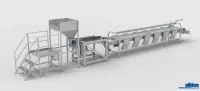 ASM 700 | 600 kg/h | Cleaning screen and a wide, lit conveyor for several operators | View Line ASM 700 Get a quote ASM 700 |


Not sure which line you need?
Tell us what you process and how much per season, and we'll recommend the line.
FAQ
Questions about processing lines for walnuts
Which walnut line do I need for each processing stage?
The Integral Line M dehulls, washes, dries and fills big bags starting from walnut with husk. CR lines size in-shell walnuts into 5 or 6 commercial sizes. AP lines crack the sized walnut and deliver clean, classified kernel, and the ASM 700 handles final kernel cleaning and manual selection.
What capacities do Albion walnut lines cover?
For sizing, from 450 kg/h with the CR 800 5T up to 1,800–1,900 kg/h with the CR VC 2000 6T. For cracking, from 300–350 kg/h with the AP 300 up to 600–650 kg/h with the AP 700, measured in calibrated in-shell walnut. The Line M processes 2,000–2,500 kg/h of walnut with husk, and the ASM 700 handles 600 kg/h.
What's the difference between dehulling, sizing and cracking walnuts?
Dehulling removes the green husk walnuts carry when they come in from the field; on the Line M, a rotary huller does it after washing. Sizing classifies in-shell walnuts by size in a perforated rotary cylinder. Cracking breaks the shell to release the kernel, which is then cleaned and classified by size.
Can I add a Taiho or Visys optical sorter to my walnut line?
Yes. The Taiho sorter slots in as a module within any Albion walnut line and adds color sorting, for example to separate black walnuts from extralight. Visys adds X-ray and hyperspectral scanning on cracking and sorting lines to detect shell fragments, glass or metal. Both are brands Albion distributes in Argentina, not Albion-made equipment.
How do I request a quote for a walnut line?
Use the Request a Quote button on any line page, or our contact page. Tell us what condition your walnuts arrive in, the volume you expect to process, and whether the line is for a new plant or replaces existing equipment. With that information we can send you an accurate quote.