
How to Choose a Walnut Processing Line: A Technical Guide for Producers
How to choose a walnut processing line: dehulling, sizing, cracking and kernel sorting, the 11 Albion models and how to size by annual volume.
If you grow or process walnuts, the question isn’t just whether to mechanize, but which stage to mechanize first. Between harvest and packing, walnuts go through dehulling, washing and drying, sizing, cracking and kernel selection, and each stage calls for a different machine. The right choice depends on the condition your walnuts arrive in and the condition you sell them in.
This guide walks through the process stages, the 11 configurations Albion builds for walnuts, how to size by volume, and when to add optical sorting.
Why mechanize walnut processing?
- Commercial uniformity. A rotary cylinder sizer classifies every walnut into commercial sizes and delivers a homogeneous product that is easier to pack and sell.
- More halves. The butterfly (the half) is the highest-value kernel. Cracking tuned to each size releases the kernel without damaging it.
- Continuous flow. Chained elevators, screens and aspirators automate a complex process and reduce labor.
- The whole chain under your own roof. With dehulling, washing and drying in a single line, you don’t depend on outside contractors for drying.
The stages of walnut processing
1. Dehulling, washing and drying
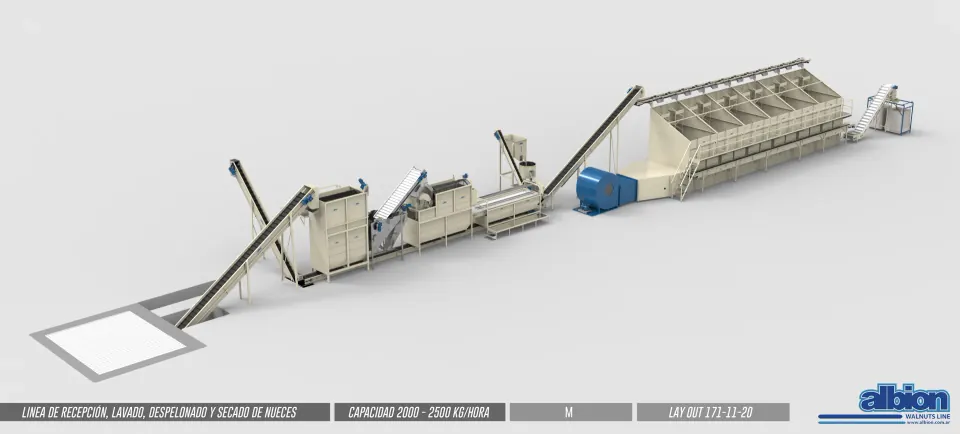
This stage takes walnuts straight from the field, green husk still on. The Integral Line M handles reception and pre-cleaning, double washing, dehulling with a rotary huller, manual inspection, oven drying and big-bag filling. The ovens are modular: you can add modules without replacing the line.
2. Sizing
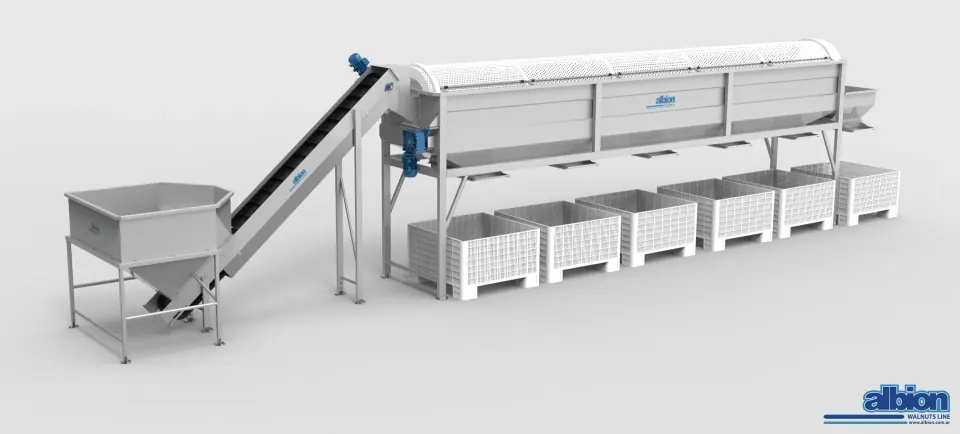
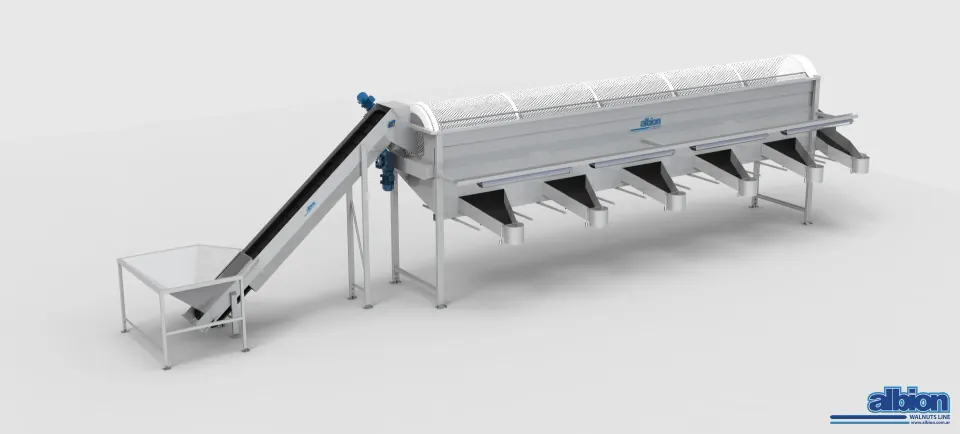
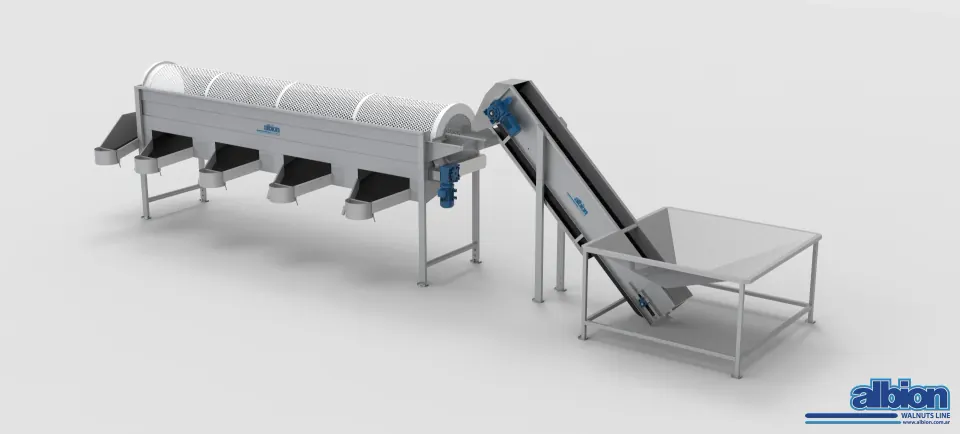
Classifies in-shell walnuts by size in a perforated rotary cylinder, either to sell them in commercial sizes or to prepare them for cracking.
3. Cracking and selection
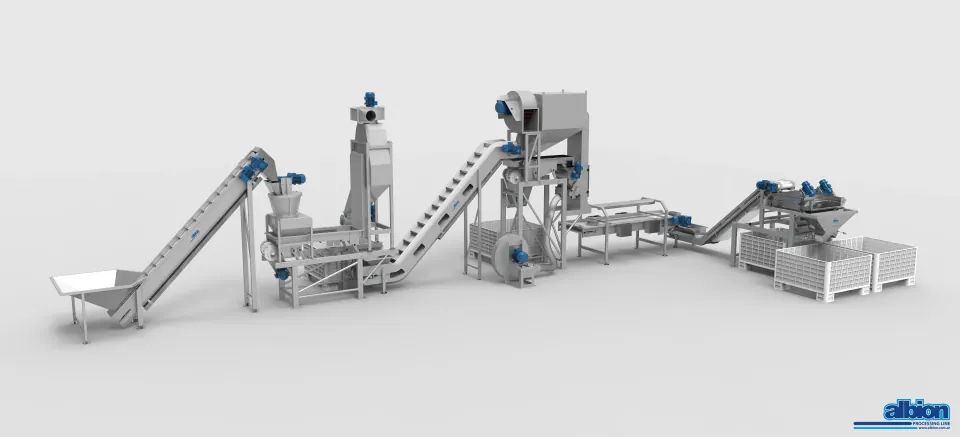
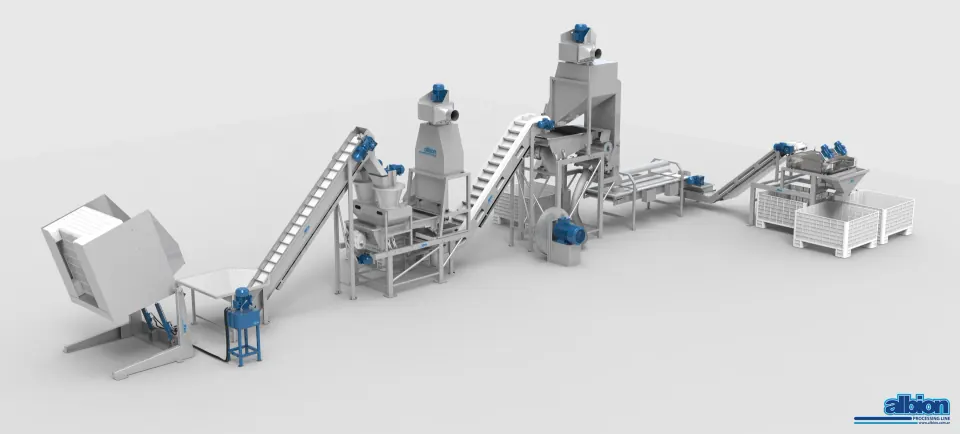
Breaks the shell with an inverted-cone cracker, separates the shell through screens and aspiration, and classifies the kernel by size into its commercial categories.
4. Manual kernel selection
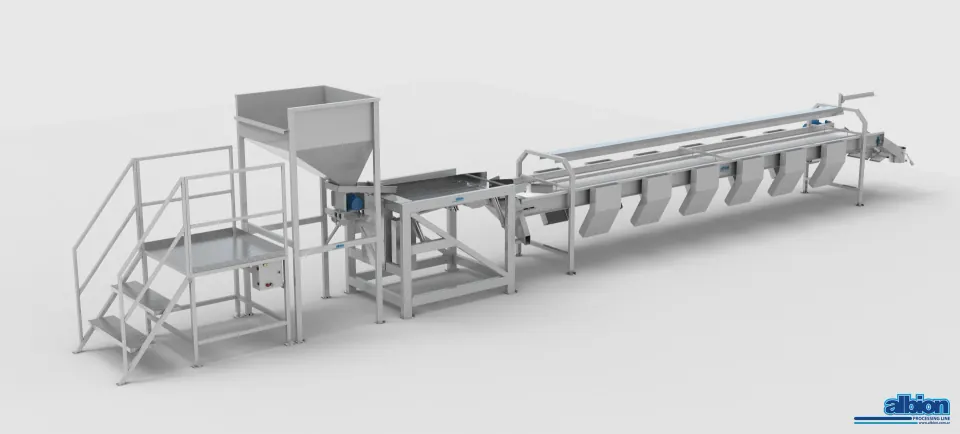
This is the final quality control: the ASM 700 cleans the kernel on a vibrating screen and spreads it over a wide, adjustable-speed conveyor with dedicated lighting, where several operators inspect it.
The 11 walnut configurations
Albion builds eleven walnut configurations across four families. What changes between families isn’t just capacity: each family handles a different stage of the process.
| Model | Capacity | What it includes / who it’s for |
|---|---|---|
| M | 2,000–2,500 kg/h (walnut with husk) | Dehulling, washing, drying and big bags. Cooperatives and medium-to-large plants |
| CR 800 5T | 450 kg/h | Ø800 cylinder, 5 sizes. For standardizing production |
| CR 800 6T | 600 kg/h | Ø800 cylinder, 6 sizes. Producers already operating at scale |
| CR 1000 5T | 900–1,000 kg/h | Ø950 cylinder, 5 sizes. Industrial capacity |
| CR 1000 6T | 900–1,000 kg/h | Ø950 cylinder, 6 sizes, lateral outlets to bags |
| CR 1000 6T BC | 900–1,000 kg/h | The same sizer with central discharge into bins |
| CR VC 2000 6T | 1,800–1,900 kg/h | Parallel Ø1000 sizers, 6 sizes. Large packers and cooperatives |
| AP 300 | 300–350 kg/h (calibrated in-shell walnut) | One cracking cone, two-stage cleaning and a quarters and pieces separator |
| AP 700 | 600–650 kg/h (calibrated in-shell walnut) | Bin tipper and parallel cones. Processors serving kernel export markets |
| AP 700 without bin tipper | 600–650 kg/h (calibrated in-shell walnut) | For plants with a silo, elevated hopper or their own conveyor |
| ASM 700 | 600 kg/h | Manual kernel selection, a complement to the AP lines |
On the CR 1000 6T BC, the BC suffix indicates central bin discharge.
How the process changes between families
Sizing: from one cylinder to several in parallel
- CR 800 5T and 6T: a Ø800 cylinder with lateral outlets for bag filling. The 6T adds one size and goes from 450 to 600 kg/h on the same footprint.
- CR 1000: a Ø950 cylinder, longer than the Ø800 to sustain industrial flow. The BC version collects each size beneath the cylinder and routes it to central bins, eliminating intermediate handling and enabling integration with automatic palletizers.
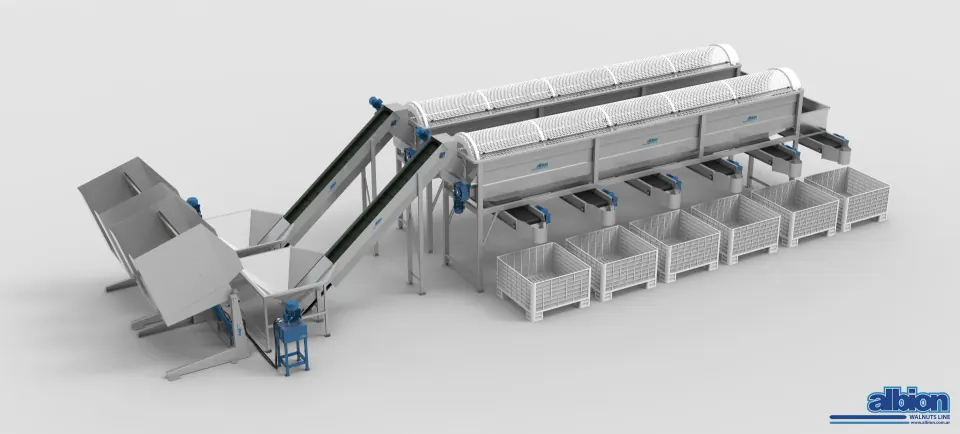
- CR VC 2000 6T: several Ø1000 drum sizers in parallel, with extraction and blending belts. Each output can be bagged or diverted to blending bins depending on its commercial destination.
Cracking: one cone or several in parallel
- AP 300: an inverted-cone cracker with a height-adjustable inner cone. Then come two stages of screening and aspiration, the second with a mega aspirator, followed by an inspection conveyor and a quarters and pieces separator.
- AP 700: multiple inverted cones in parallel, each tuned to the size it receives. It doubles the AP 300’s capacity without losing cracking precision, starts with a bin tipper and size-grades the kernel into butterflies (halves), quarters and pieces, taking care to keep the butterfly as whole as possible.
- AP 700 without bin tipper: same capacity, but it starts with an elevator that receives flow from your existing loading system. You skip the tipper, and the line fits in more compact spaces.
The AP 700 lines are designed to integrate with the CR 1000 6T or the CR VC 2000 6T, keeping the flow between sizing and cracking balanced.
How to choose by volume
The math is: annual capacity = hourly capacity × hours per day × days per year. We assume standard operation of 8 hours a day × 200 days a year = 1,600 hours. If your season is shorter, adjust the days to the actual period.
Reference table (8 hrs × 200 days)
| Stage | Model | Capacity | Indicative annual volume |
|---|---|---|---|
| Dehulling | M | 2,000–2,500 kg/h | 3,200–4,000 t of walnut with husk |
| Sizing | CR 800 5T | 450 kg/h | 720 t |
| Sizing | CR 800 6T | 600 kg/h | 960 t |
| Sizing | CR 1000 (5T, 6T, 6T BC) | 900–1,000 kg/h | 1,440–1,600 t |
| Sizing | CR VC 2000 6T | 1,800–1,900 kg/h | 2,880–3,040 t |
| Cracking | AP 300 | 300–350 kg/h | 480–560 t of calibrated in-shell walnut |
| Cracking | AP 700 (with or without bin tipper) | 600–650 kg/h | 960–1,040 t of calibrated in-shell walnut |
| Kernel selection | ASM 700 | 600 kg/h | 960 t |
⚠ Important: these figures are indicative only; they simply multiply the published capacity by the assumed hours. Each line works on a different product (walnut with husk, in-shell walnut or kernel), so to chain stages together we size the lines with your own operating data.
Worked example
Say you need to crack 800 metric tons of calibrated in-shell walnut per season: 800,000 kg ÷ 1,600 hours = 500 kg/h on average.
→ An AP 300 (300–350 kg/h) would need roughly 2,290 to 2,670 hours, more than the 1,600 assumed. An AP 700 (600–650 kg/h) handles it in roughly 1,230 to 1,330 hours, leaving headroom for seasonal peaks.
Equipment you can add
Albion also builds individual equipment that can be integrated into existing lines or bought as standalone units: the VB 500 hydraulic bin tipper, which tips product without impact or free fall; elevators with paddle belts; the inspection conveyor with adjustable speed and dedicated lighting; and the PES 25 weigher-bagger, programmable for 10 to 25 kg sacks of nuts.
Optical sorting: Taiho and Visys
Albion distributes two optical sorting brands in Argentina that integrate with its walnut lines. They are not Albion-made equipment: they are brands Albion represents.
- Taiho (China): AI-powered optical sorters. They slot in as a color-sorting module on Albion walnut cracking and kernel selection lines. The configuration we build in Argentina combines a receiving hopper, a bucket elevator, a Taiho sorter and two output conveyors that split the product by color, for example black walnuts and extralight. Learn more on the Taiho page.
- Visys (Turkey): optical sorters with RGB cameras, laser, X-ray and hyperspectral sensors. On cracking and sorting lines, Visys complements Taiho: it detects shell fragments, glass or metal that color cameras alone cannot see. It’s the final module that shields the exporter from claims. Learn more on the Visys page.
Warranty, pre-assembly, financing and support
Albion is a Mendoza company founded on April 20, 1966, by Atilio César Dal Pozzo. Today it’s led by the second generation, with the third already joining, and it has more than 50 in-house experts. What comes with every line:
- 12-month warranty on mechanical parts of Albion’s own manufacture. It doesn’t cover consumables or damage caused by improper maintenance.
- Pre-assembled and concatenated in our workshop: the line arrives ready to assemble on-site.
- Financing: many customers finance through Argentina’s Banco Nación credit lines for domestic industrial machinery. You handle the application with the bank; Albion issues the documentation.
- Support: Albion equipment operates in 18 countries on 6 continents. After-sales technical support is concentrated in Latin America, but equipment ships to any market in the world.
Next step
To recommend the right configuration, tell us:
- What condition your walnuts arrive in (with husk, in-shell or as kernel) and what you sell.
- How much you process per season and how many hours a day the line would run.
- How you load today (bins, silo, elevated hopper) and how much space you have in your building.
See photos and specs on our Walnuts page, or contact us to start your quote.
Frequently asked questions
- Do I need equipment for every stage, or can I start with just one?
- It depends on the condition your walnuts arrive in and the condition you sell them in. If you sell in-shell walnuts, a CR sizing line can be your starting point. If you sell kernel, you need an AP cracking line, and it's best to size first because AP lines work with calibrated in-shell walnut. If your walnuts come in from the field with the husk still on, the first stage is the Integral Line M for dehulling, washing and drying.
- Why size walnuts before cracking them?
- Because mechanical cracking is tuned by size: the cracking cone on AP lines has mechanical adjustment for each size grade and applies the exact pressure each walnut size needs. Well-sized walnuts reduce kernel breakage and increase halves recovery, the highest-value product. In fact, AP capacity is stated in calibrated in-shell walnut.
- What's the difference between the AP 700 and the AP 700 without bin tipper?
- How the line starts. The AP 700 begins with a hydraulic bin tipper that discharges into the elevator. The version without bin tipper starts directly with an elevator that receives flow from your existing loading system, such as a silo, an elevated hopper or your own conveyor belt. Both keep the same cracking, selection and classification architecture and the same capacity of 600–650 kg/h of calibrated in-shell walnut.
- Should I choose a sizer with lateral outlets or with central bin discharge?
- The CR 1000 6T discharges each size through lateral outlets designed for direct bag filling. The CR 1000 6T BC uses the same 6-size Ø950 sizer, but collects each size beneath the cylinder and routes it to centrally positioned bins. It's the option for plants that handle product in bins during storage or work with automatic palletizing.
- Why add an ASM 700 if the cracking line already has an inspection conveyor?
- The ASM 700 is a line dedicated to final kernel quality control. Before manual inspection, a vibrating cleaning screen removes small shell pieces and fine particles that may remain from cracking. The kernel then moves over a wide, adjustable-speed conveyor with dedicated lighting, where several operators review it and classify it to your quality standards. With capacity of up to 600 kg/h, it's designed to complement the AP 300 and AP 700.
- When should I use a Taiho sorter and when a Visys sorter?
- Taiho (China) adds color sorting: the configuration we build in Argentina separates, for example, black walnuts from extralight. Visys (Turkey) adds X-ray and hyperspectral scanning to detect shell fragments, glass or metal that color cameras alone cannot see: it's the final module that shields the exporter from claims. On cracking and sorting lines, Visys complements Taiho. Neither is Albion-made: both are brands Albion distributes in Argentina.
- What does the warranty cover, and how does the line arrive at my plant?
- Lines carry a 12-month warranty on mechanical parts of Albion's own manufacture. The warranty doesn't cover consumables or damage caused by improper maintenance. Every line is pre-assembled and concatenated in our workshop before dispatch, so it arrives ready to assemble on-site.
- Is financing available, and what about after-sales support?
- Many customers finance the investment through Argentina's Banco Nación credit lines for domestic industrial machinery: you handle the application with the bank and Albion issues the necessary documentation. Albion equipment operates in 18 countries on 6 continents. After-sales technical support is concentrated in Latin America, but equipment ships to any market in the world.
Lines mentioned in this article
Ready to size your processing line for walnuts?
Send us your operation's basic data and we'll prepare a proposal sized to your volume and your warehouse.
Request a quote