
How to Choose a Prune Processing Line: A Technical Guide
Sizing or pitting? Albion's 17 prune lines, their capacities, what each family includes and how to size your line by annual volume.
If you process dried prunes, the first decision isn’t how many kilos per hour you need: it’s what product you’re going to sell. A prune graded by size and a pitted, brightened and weighed prune come off different lines.
This guide is for the producer, packer or cooperative considering mechanizing their plant: the two processes Albion covers, its 17 configurations, how to estimate the capacity you need and when to add optical sorting.
Why mechanize processing?
- Mechanical grading. Vibrating screens and perforated plates separate the fruit into commercial sizes, in continuous flow.
- More selling options per kilo. Depending on the model, the line delivers 7, 9, 13 or 15 commercial sizes in a single pass, and each size is a price point.
- Less handling. The hydraulic bin tipper unloads product without impact or free fall.
- One end-to-end flow. In pitting, the same line washes, inspects, conditions, pits, brightens and weighs.
Two processes, two types of line
Sizing: grading by size
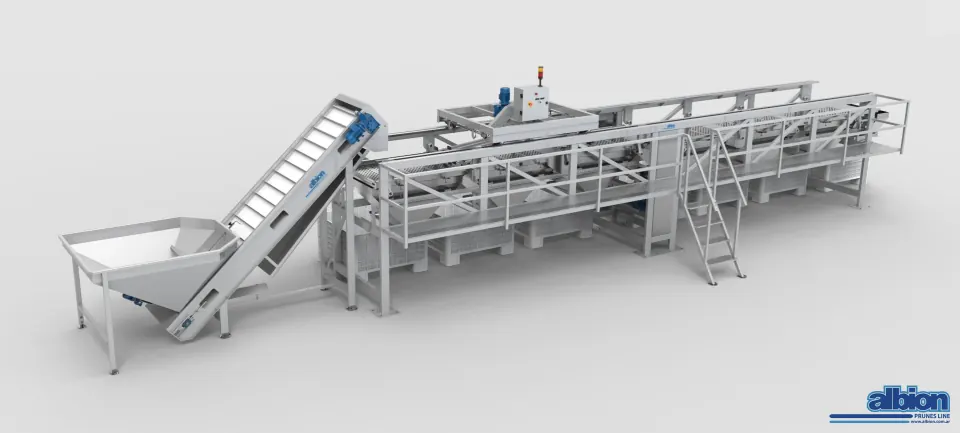
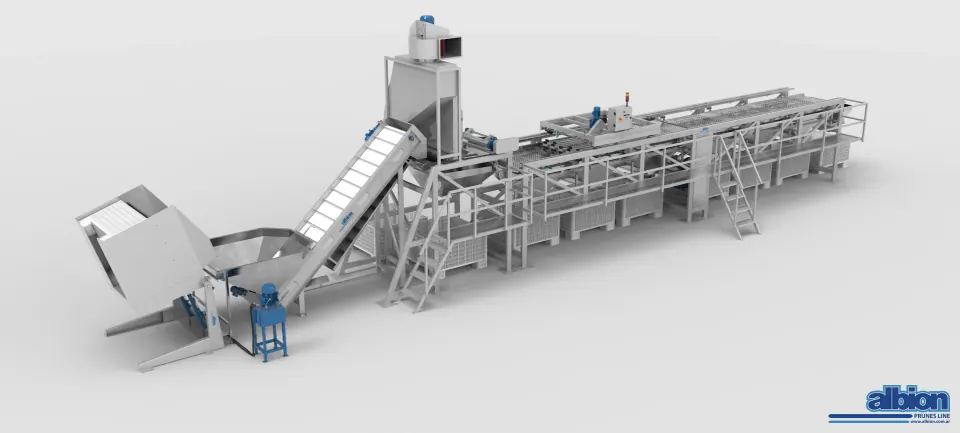
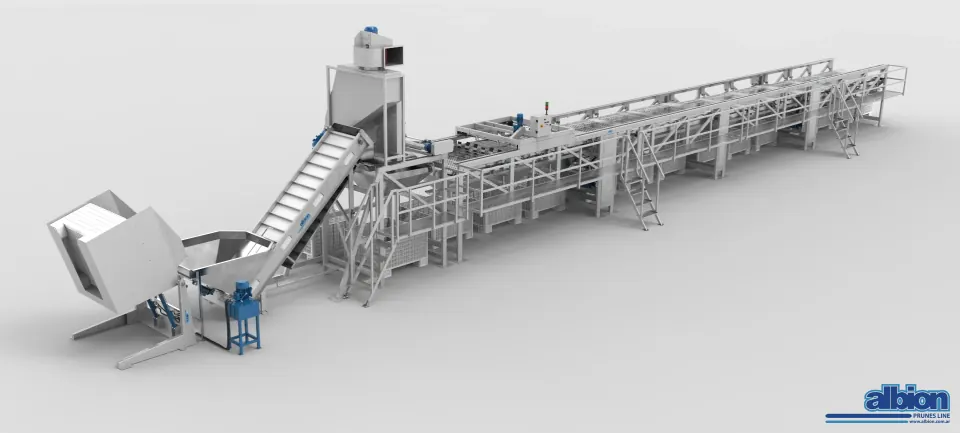
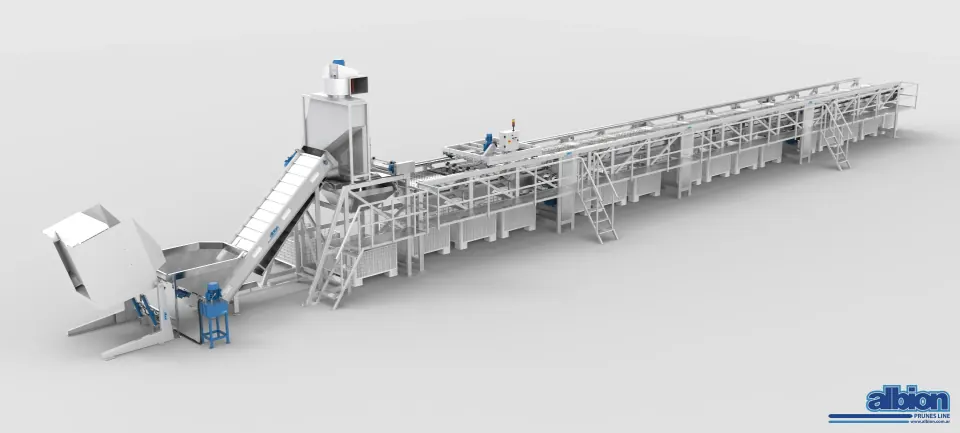
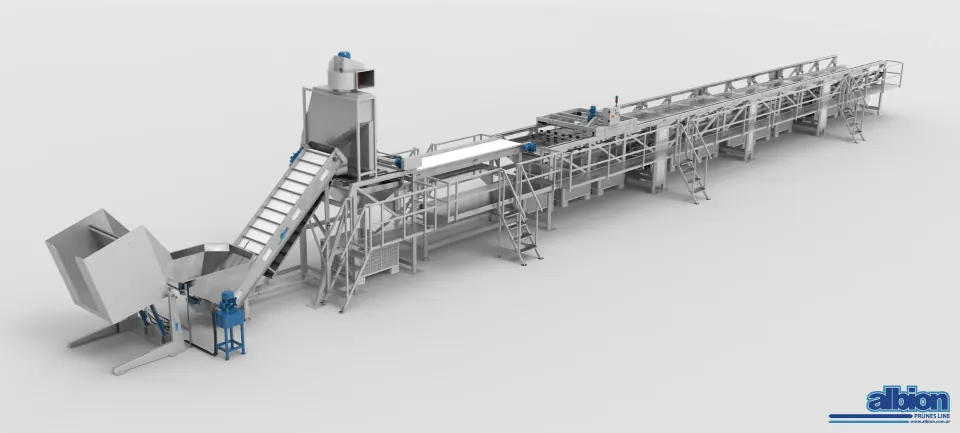
Every sizing line shares the same core: an elevator with dosing hopper that feeds the line in continuous flow, a sizer with interchangeable perforated plates (hole diameters are chosen according to the sizes you want to obtain) and an automatic mobile cart with rubber paddles that keeps fruit from sticking to the plates.
Depending on the family, the line adds ahead of the sizer a hydraulic bin tipper, a cleaning screen that removes fines, loose pits and plant debris, a vacuum aspirator that removes peduncles, leaves and light particles and, in the CF family, an illuminated inspection conveyor.
Pitting: from bin to weighed product
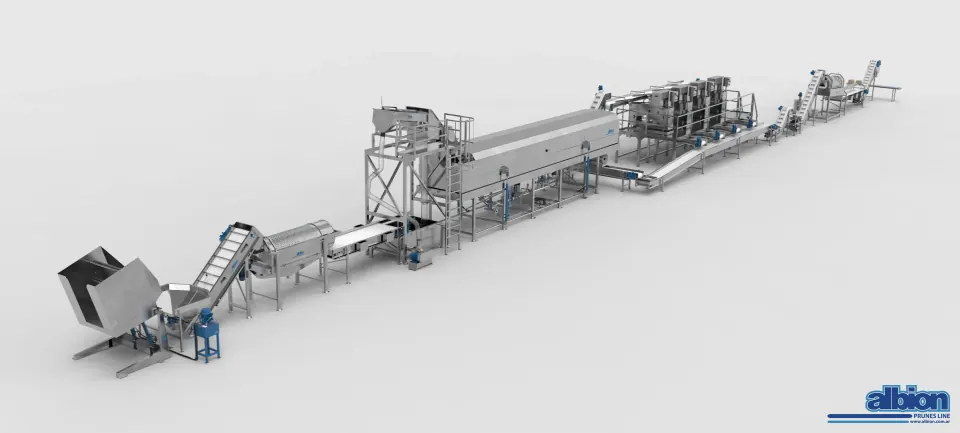
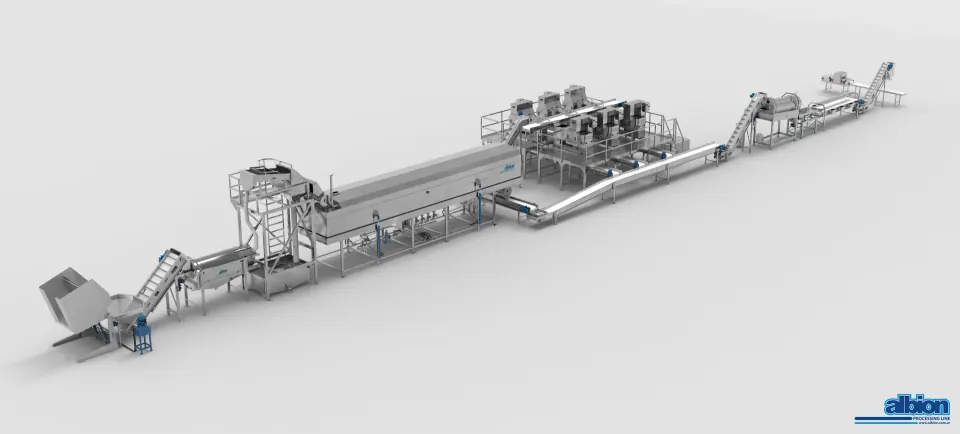
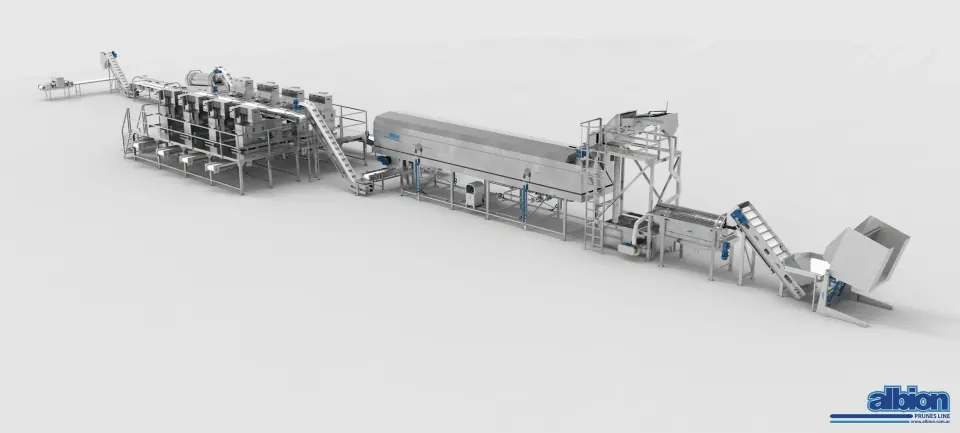
The integral pitting lines bring together 21 machines in four sectors in continuous flow:
- Washing and initial inspection: bin tipper, elevator, rotary washer, an inspection conveyor where operators remove damaged fruit or foreign matter, and a single-cascade washer.
- Conditioning: a continuous hydrator-tenderizer, a closed tunnel where the prune takes on moisture and temperature from direct steam, with variable residence time.
- Pitting: a conveyor with adjustable deflectors distributes the flow among the pitters, whose step-by-step head adjusts to any prune size; the knives extract the pit through the natural opening without damaging the pulp.
- Finishing: cleaning screen, a brightener that applies brightening agent and sorbate, illuminated inspection conveyor, weighing elevator that doses fixed quantities for packing, and roller conveyor.
The whole line is built in AISI 304 stainless steel from washing to output, resistant to the prune’s natural acid attack and to daily sanitary washing.
The 17 configurations Albion manufactures
| Family | Models and capacity | What it includes / who it’s for |
|---|---|---|
| CA | CA 1000 7T and CA-E 1000: 700–800 kg/h · CA 1200: 1,200–1,400 kg/h | 3 modules: elevator, sizer and mobile cart. 7 sizes (9 on the CA-E 1000). For fruit that arrives pre-cleaned. |
| CD (sizing) | CD 1200: 1,200–1,400 kg/h · CD 1500: 2,500–2,700 kg/h | 6 modules: adds a bin tipper, cleaning screen and vacuum aspirator ahead of a 7-size sizer. |
| CE | CE 1200: 1,500–1,700 kg/h · CE 1500: 2,800–3,000 kg/h · CE 1800: 3,500–3,800 kg/h | 6 modules with a 13-size sizer in two bodies. For markets that pay for fine subdivision. |
| CE-E | CE-E 1200: 1,500–1,700 kg/h · CE-E 1500: 2,800–3,000 kg/h · CE-E 1800: 3,500–3,800 kg/h | Same architecture as the CE, with 15 sizes: the family maximum. |
| CF | CF 1200: 1,200–1,400 kg/h · CF 1500: 2,500–2,700 kg/h · CF 1800: 3,300–3,500 kg/h | 7 modules: adds a manual inspection conveyor ahead of the 13-size sizer. Visual control before grading. |
| CD (pitting) | CD 4: 1,100 kg/h · CD 6: 1,600 kg/h · CD 8: 2,200 kg/h | Integral line of 21 machines with 4, 6 or 8 pitters. The CD 6 and CD 8 add a metal detector. |
Watch the model names: the CD 1200 and CD 1500 are sizing lines; the CD 4, CD 6 and CD 8 are pitting lines. They share letters but handle different processes. In sizing lines, the model number is the sizer’s working width in millimeters (the CD 1200 sizes on 1,200 mm); in pitting lines, it’s the number of pitters (the CD 6 has six).
How the process changes between families
- From CA to CD: the CD 1200 adds a bin tipper, cleaning screen and aspirator at the head of the line. The sizer always receives clean product, which preserves sizing accuracy and reduces mechanical wear.
- From CD to CE and CE-E: the six modules stay and the sizer changes: 13 sizes (12 lateral + 1 end) in two bodies, or 15 (14 + 1) on the CE-E. The question is commercial: do your buyers pay differently for each size?
- From CE to CF: the CF adds the inspection conveyor between cleaning and the sizer. On the CF 1500 and CF 1800, the conveyor is designed for several operators working in parallel.
- From CD 4 to CD 8: the four sectors stay; the number of pitters changes. The CD 4 is for medium-scale processors. The CD 6 and CD 8 add a metal detector at the exit.
How to size your line by annual volume
Annual capacity = hourly capacity × hours per day × days per year
Assumption: standard operation of 8 hours per day × 200 days per year = 1,600 hours/year. If your plant only runs part of the year, adjust the days to the actual period.
Reference table (8 hrs × 200 days)
| Hourly capacity | Approximate annual volume | Models |
|---|---|---|
| 700–800 kg/h | 1,120–1,280 t | CA 1000 7T, CA-E 1000 |
| 1,100 kg/h | 1,760 t | CD 4 (pitting) |
| 1,200–1,400 kg/h | 1,920–2,240 t | CA 1200, CD 1200, CF 1200 |
| 1,500–1,700 kg/h | 2,400–2,720 t | CE 1200, CE-E 1200 |
| 1,600 kg/h | 2,560 t | CD 6 (pitting) |
| 2,200 kg/h | 3,520 t | CD 8 (pitting) |
| 2,500–2,700 kg/h | 4,000–4,320 t | CD 1500, CF 1500 |
| 2,800–3,000 kg/h | 4,480–4,800 t | CE 1500, CE-E 1500 |
| 3,300–3,500 kg/h | 5,280–5,600 t | CF 1800 |
| 3,500–3,800 kg/h | 5,600–6,080 t | CE 1800, CE-E 1800 |
These figures are orientative: each line’s published capacity multiplied by the assumed hours.
Orientative example
To process 2,000 metric tons per year with standard operation: 2,000,000 kg ÷ 1,600 hrs = 1,250 kg/h on average.
- For sizing, that falls within the 1,200–1,400 kg/h range (CA 1200, CD 1200 or CF 1200, depending on how much cleaning and inspection you need). For headroom, the next step up is 1,500–1,700 kg/h (CE 1200 or CE-E 1200).
- For pitting, the CD 4 (about 1,760 t per year under this assumption) falls short; the CD 6 (about 2,560 t) covers the volume with margin.
If that volume has to be processed in half the days, the required capacity doubles: 2,500 kg/h.
Equipment you can add
If your plant already has part of the process covered, Albion also manufactures standalone equipment: elevators for prunes, the VB 500 hydraulic bin tipper and inspection conveyors with adjustable speed. You’ll find them under Equipment. And the CA 1000 7T belongs to the same technical family as the CD, CE and CF: as volume grows, components are interchangeable.
Optical sorting with Visys
Visys is a Turkish optical-sorter manufacturer, founded in 2004 in Istanbul, that combines RGB cameras, laser, X-ray and hyperspectral sensors. It is not Albion equipment: Albion represents and distributes the full line in Argentina.
On prunes, Visys works after pitting: using X-ray, it identifies residual pit fragments inside the flesh, a critical defect that human inspection cannot reliably catch at industrial speed. It’s key if you export to markets where a single fragment can trigger a claim. It isn’t the same as the metal detector on the CD 6 and CD 8, which is the final control against metallic contamination.
Warranty, pre-assembly, financing and support
- 12-month warranty on mechanical parts of Albion’s own manufacture. It does not cover consumables or damage from improper maintenance.
- Pre-assembled and concatenated in the workshop: the line is put together at Albion before dispatch and arrives ready to install on-site.
- Financing: many customers finance the investment through Banco Nación credit lines for national industrial machinery. You handle the application with the bank; Albion issues the required documentation.
- Support: after-sales technical support is concentrated in Latin America, but Albion ships equipment worldwide. Albion equipment is operating today in 18 countries across 6 continents.
Albion was founded on April 20, 1966, in Mendoza by Atilio César Dal Pozzo. Today the second generation leads the company, the third is joining, and the team brings together more than 50 in-house experts.
Next step
To recommend a line, we need to know:
- Which process you need: sizing, pitting or both.
- Your estimated annual volume and how many hours and days your plant runs.
- How many sizes your buyers ask for and whether the fruit arrives pre-cleaned.
With that, we’ll propose the configuration that fits your case. See all 17 lines on our Prunes page or contact us to start your quotation.
Frequently asked questions
- What is the difference between a sizing line and a pitting line?
- They are two different processes. The sizing lines (CA, CD 1200/1500, CE, CE-E and CF families) grade dried prunes into 7, 9, 13 or 15 commercial sizes, depending on the model. The integral pitting lines (CD 4, CD 6 and CD 8) take the fruit from the bin, wash it, condition it with steam, remove the pit and deliver it brightened and weighed for packing.
- Why don't the CA lines include a cleaning screen or an aspirator?
- Because they are designed for producers who already have their own pre-cleaning and only need the sizing stage. They have three modules: an elevator with dosing hopper, the sizer and an automatic mobile cart. If your fruit doesn't arrive clean, the CD 1200, the CD 1500 and the CE, CE-E and CF families add a hydraulic bin tipper, a cleaning screen and a vacuum aspirator ahead of the sizer.
- How many sizes do I need: 7, 9, 13 or 15?
- It depends on how many sizes your buyers pay differently for. The CA 1000 7T, CA 1200, CD 1200 and CD 1500 work with 7; the CA-E 1000 with 9; the CE and CF lines with 13; and the CE-E lines with 15, the family maximum. Each additional size is one more price point per kilogram processed; if your market doesn't differentiate them, a smaller matrix is enough.
- What does the CF family add compared with the CE?
- A manual inspection conveyor, with lighting, before sizing. There, operators remove visual defects, darkened prunes or out-of-spec product before it reaches the sizer. CF lines work with 13 sizes and range from 1,200–1,400 kg/h (CF 1200) to 3,300–3,500 kg/h (CF 1800).
- How do the CD 4, CD 6 and CD 8 differ?
- All three are integral lines with 21 machines across four sectors; what changes is the number of pitters and, with it, the capacity: 1,100, 1,600 and 2,200 kg/h. The CD 6 and CD 8 add a metal detector at the exit. On the CD 8, modularity lets the line keep running with 7 pitters while one is under maintenance, without stopping the plant.
- Do the pitters adapt to different prune sizes?
- Yes. Each pitter has a step-by-step head adjustable to any prune size, and the knives extract the pit through the natural opening without damaging the pulp. Before that, the continuous hydrator-tenderizer conditions the fruit with direct steam, with variable residence time.
- Where does Visys fit into the line?
- After pitting. Visys (Turkey) identifies residual pit fragments inside the flesh, a defect human inspection cannot reliably catch at industrial speed. It is a brand Albion represents and distributes in Argentina, not equipment Albion manufactures.
- What does the warranty cover, and how does the line arrive at my plant?
- Mechanical parts of Albion's own manufacture carry a 12-month warranty; it does not cover consumables or damage from improper maintenance. Lines are pre-assembled and concatenated in Albion's workshop before dispatch, so they arrive ready to install on-site.
Lines mentioned in this article
Ready to size your processing line for prunes?
Send us your operation's basic data and we'll prepare a proposal sized to your volume and your warehouse.
Request a quote