
How to Choose Your Almond Cracking Line: ALP 300 or ALP 700
A guide to choosing your almond cracking line: process stages, ALP 300 and ALP 700 capacities, and how to size the line to your annual volume.
If you grow almonds or buy them to process, cracking is the stage where your kernel’s value is won or lost: you have to break a hard shell without damaging the kernel, thoroughly separate the debris, and sort the product into commercial categories. Choosing a line means deciding how you’ll do that job for many seasons to come.
This guide is for you if you’re considering industrializing your almond cracking: the process stages, the two configurations Albion manufactures — ALP 300 and ALP 700 — how they differ, and which one fits your volume. Albion is a family company from Mendoza, Argentina, founded in 1966, with equipment operating today in 18 countries across 6 continents.
Why mechanize cracking?
- Pressure set to the shell. The inverted-cone cracker is firm with the hard shell and gentle with the kernel, and it’s mechanically adjusted to the almond’s size grade.
- More whole almonds. The line protects the kernel at every stage to maximize the share of whole almonds — which is where profitability lies.
- Two-step cleaning. A screen with a vacuum aspirator first separates a high percentage of the broken shell, then a Mega Aspirator removes nearly all of what remains.
- Ready-to-sell product. The kernel comes out sorted into commercial categories, ready for packaging.
The stages of almond cracking
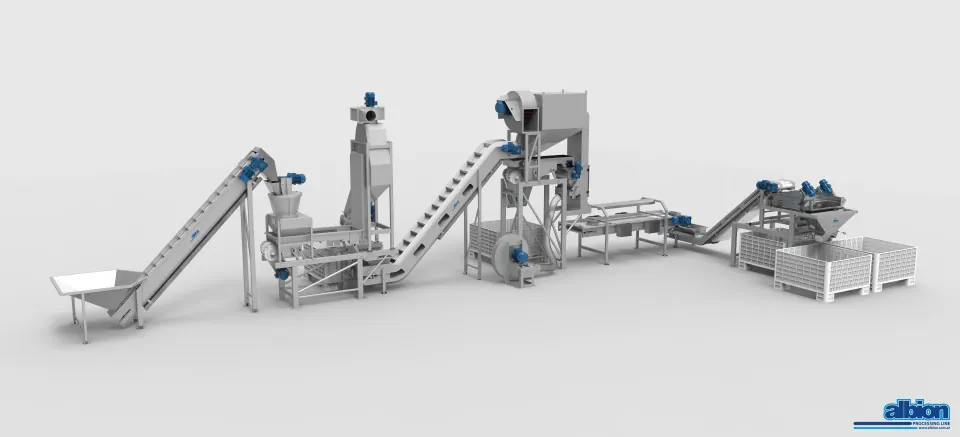
Both lines follow the same architecture — cracking, selection, and classification — and take the in-shell almond to classified kernel in six steps.
1. Feeding
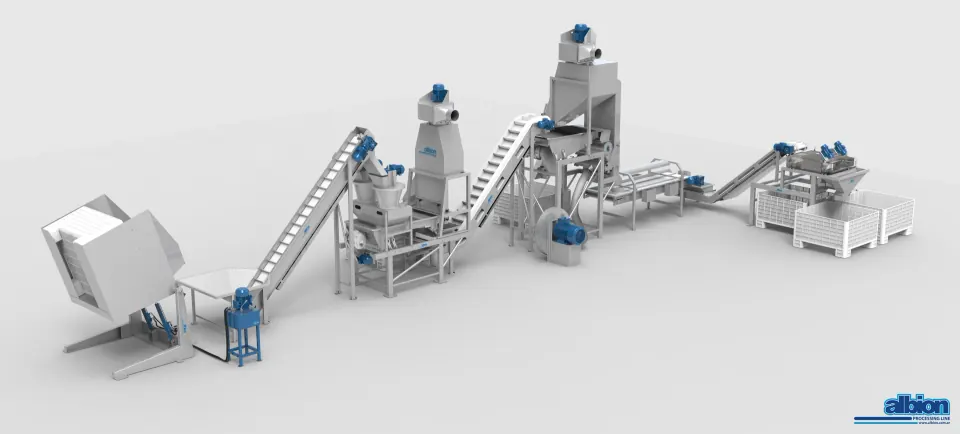
An elevator feeds the cracker smoothly and continuously. On the ALP 700, a hydraulic bin tipper comes first: continuous volume, no waiting between dumps.
2. Inverted-cone cracking
This is the heart of the system: a cracker assembly with a coated cast-aluminum exterior and a mechanically adjustable inner cone, set to the shell diameter of Nonpareil, Guara, Soleta, and similar varieties. The ALP 300 runs a single cracker; the ALP 700 runs several cones in parallel.
3. First separation
After cracking, a separating screen with stainless-steel mesh and a vacuum aspirator do the first major cleaning, separating a high percentage of the broken shell.
4. Deep aspiration cleaning
An elevator carries the pre-separated mix to a high-efficiency Mega Aspirator, which removes nearly all remaining shell and light particles.
5. Inspection
On a wide inspection conveyor, operators carry out final quality control, removing impurities, darkened almonds, or defective fragments.
6. Kernel classification
A final elevator takes the clean kernel to classification, which separates it into whole kernels and broken kernels, ready for packaging.
The two configurations
Both lines are the almond version of the mechanical-cracking architecture behind the AP 300 and AP 700 walnut lines, with the cracker assembly calibrated for the hard almond shell.
| Model | Capacity | What’s included / who it’s for |
|---|---|---|
| ALP 300 | 300–350 kg/h (calibrated in-shell almond) | 9 machines, from whole almond to classified kernel, with a single inverted-cone cracker and a final sizer. The entry point to industrial cracking for mid-size producers and processors industrializing their own harvest. |
| ALP 700 | 600–650 kg/h (calibrated in-shell almond) | 10 machines, from bin to classified kernel: adds a hydraulic bin tipper and a set of parallel crackers. Built for processors serving kernel export markets. |
How they differ
The ALP 700 takes the ALP 300 philosophy to industrial scale. Beyond capacity, four things change:
- The start of the line. The ALP 300 starts at an elevator; the ALP 700 adds a hydraulic bin tipper ahead of it.
- Cracking. The ALP 700 replaces the single cracker with a set of inverted cones in parallel, each tunable to the size grade it receives. That’s how it doubles capacity without losing cracking precision while keeping the share of whole almonds high at volume.
- Equipment sizing. The separating screen is sized for industrial flow, and every component is oversized to sustain complete harvest seasons.
- Final classification. On the ALP 300 it’s done by a sizer; on the ALP 700, by a kernel separating screen fed by a final elevator. The output categories are the same.
What stays the same: SAE 1010 mild-steel structures with an anticorrosive primer and polyurethane enamel, meshes and screens in product contact in AISI 304 stainless steel with a sanitary polish, oil-bath gearmotors, and fully shielded three-phase motors.
How to choose by volume
Both lines’ capacity is stated in calibrated in-shell almond: what goes into the line, not the kernel that comes out. That’s the number to compare with your volume.
Annual capacity = hourly capacity × hours per day × days per year
Reference table (standard operation of 8 h × 200 days = 1,600 h/year)
| Model | Capacity | Indicative annual volume of calibrated in-shell almond |
|---|---|---|
| ALP 300 | 300–350 kg/h | 480–560 metric tons |
| ALP 700 | 600–650 kg/h | 960–1,040 metric tons |
If your annual volume fits what an ALP 300 processes on that schedule, that’s your starting point; if it’s higher, look at the ALP 700.
⚠ Important: these ranges are for orientation only. If your season is concentrated into a few weeks, run the numbers with the actual days the line will run. For example, 400 metric tons over 1,600 hours works out to 250 kg/h on average, within what an ALP 300 handles; the same 400 tons over 100 eight-hour days (800 h) works out to 500 kg/h, which is ALP 700 territory.
Note: neither line’s equipment list includes calibrating the in-shell almonds. If yours don’t arrive calibrated, mention it when you request a quote.
Equipment you can add
The Equipment page lists standalone machines you can quote on their own or to integrate into an existing line:
- VB 500 hydraulic bin tipper: for the start of a line, compatible with standard 1,000×1,200 and 1,200×1,200 bins; it tips product without impact or free fall. The ALP 700 already includes a hydraulic bin tipper.
- PES 25 weigher-bagger: a programmable electronic weigher for 10 to 25 kg sacks of nuts, with a touch screen to set cut and pre-cut weights.
- Elevators and inspection conveyor: the standalone conveyor offers adjustable speed, dedicated lighting, and side bins for non-conforming product.
If you’d like to add one, bring it up when you request a quote and we’ll see how it fits.
Warranty, pre-assembly, financing, and support
- Pre-assembled in our workshop: the line is pre-assembled and concatenated before dispatch and arrives ready to install on-site.
- 12-month warranty on mechanical parts of our own manufacture. It does not cover consumables or damage caused by improper maintenance.
- Financing: many customers finance their investment through Banco Nación credit lines for domestic industrial machinery. You handle the application with the bank; Albion issues the necessary documentation.
- Support: after-sales technical support is concentrated in Latin America, but we ship equipment anywhere in the world.
Behind every line are more than 50 in-house experts and a family company Atilio César Dal Pozzo founded in Mendoza on April 20, 1966, now led by the second generation with the third joining.
Next step
- Estimate your annual volume of in-shell almonds and the period in which you’ll process it.
- Compare the two configurations on the ALP 300 and ALP 700 pages, or see everything on the Almonds page.
- Request your quote from the line page or through Contact: tell us your volume, the varieties you work with, and how your almonds arrive.
Frequently asked questions
- Are the ALP 300 and ALP 700 the same as the walnut lines?
- They share the architecture, but they are set up for almonds. The ALP 300 is the almond version of the walnut AP 300, and the ALP 700 is the almond version of the AP 700: the same inverted-cone mechanical cracking concept, with the cracker assembly calibrated for the hard almond shell.
- Which almond varieties can the line crack?
- The cracking cone's mechanical adjustment adapts to the shell diameter of Nonpareil, Guara, Soleta, and similar varieties. On the ALP 700, each cone in the parallel set has its own adjustment, so you can tune it to the size grade it receives. If you work with a different variety, tell us which one when you request a quote.
- Is capacity measured on in-shell almonds or on kernel?
- On calibrated in-shell almonds, meaning the product that goes into the line: 300–350 kg/h on the ALP 300 and 600–650 kg/h on the ALP 700. To size your line, compare those figures with your in-shell volume, not with the kernel you expect to get out.
- What categories does the kernel come out in?
- Both lines classify the kernel into whole kernels and broken kernels, ready for packaging. On the ALP 300 that step is done by a sizer; on the ALP 700, by a kernel separating screen. Before that, operators on the inspection conveyor remove impurities, darkened almonds, and defective fragments.
- Should I go with one ALP 700 or two ALP 300s in parallel?
- The ALP 700 is designed for exactly that case: its set of parallel crackers reaches 600–650 kg/h on a single line and replaces two ALP 300 units, saving floor space and labor. It also adds a hydraulic bin tipper at the start and components oversized to sustain complete harvest seasons.
- What does the warranty cover, and how does the line arrive at my plant?
- The warranty covers mechanical parts of Albion's own manufacture for 12 months. It does not cover consumables or damage caused by improper maintenance. The line is pre-assembled and concatenated in our workshop before dispatch, so it arrives ready to install on-site.
- How can I finance the line, and what support is available after purchase?
- Many customers finance their investment through Banco Nación credit lines for domestic industrial machinery: you handle the application with the bank, and Albion issues the documentation you need. After-sales technical support is concentrated in Latin America, but we ship equipment anywhere in the world.
Lines mentioned in this article
Ready to size your processing line for almonds?
Send us your operation's basic data and we'll prepare a proposal sized to your volume and your warehouse.
Request a quote