
How to Choose a Dried Tomato Processing Line: Case or Tray Filling
How to choose a dried tomato line: process stages, TO C 2800 or TO B 2800, case or tray filling for your drying setup, and how to size it.
If you process tomatoes for drying at industrial scale, there’s a lot of work before the drying itself: receiving, washing, inspecting, cutting, treating with metabisulfite and loading the drying container. Done by hand, those tasks depend on the pace of each shift. The right cutting line turns those steps into a continuous flow and delivers tomatoes ready to go into your drying system.
This guide is for you if you are considering mechanizing that part of the process. We’ll cover the line’s stages, the two configurations Albion manufactures —the TO C 2800 and the TO B 2800—, how to choose between case filling and tray filling, and how to run a rough annual volume estimate.
Why mechanize cutting and filling?
Four underlying reasons:
- Fruit integrity from the moment it’s unloaded. Receiving tomatoes directly into water reduces mechanical impact and preserves fruit integrity.
- Consistent cutting. Every tomato comes out in three longitudinal pieces, the same way every time: the optimal format for fast, uniform dehydration.
- Controlled treatment. Metabisulfite application is calibrated to industry-standard dosing, in a dedicated tank.
- The right load in every tray. On the TO B 2800, a dosing system loads each tray with the right amount of product.
The process, step by step
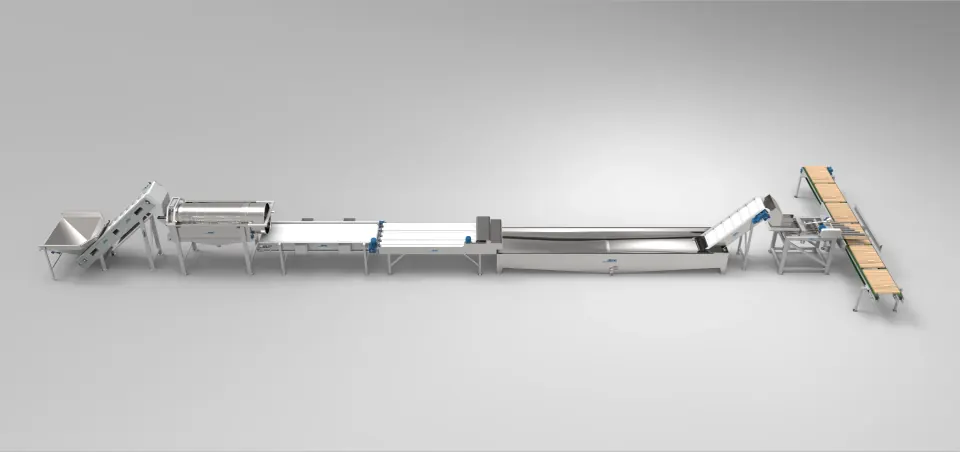
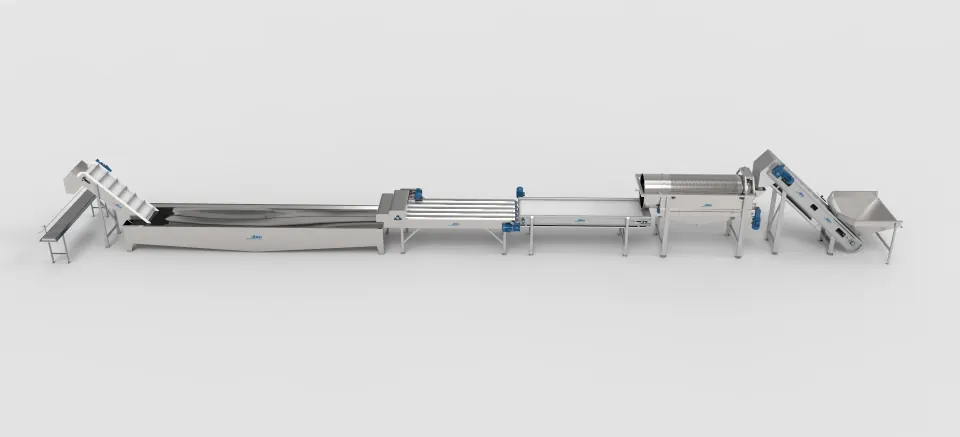
Both lines in the TO family share the same architecture: they take fresh tomatoes from the field and deliver them cut, treated and loaded for drying.
1. Water-flume receiving
The Water-Flume Receiver with Elevator takes the tomato discharge directly into water, the standard format for fresh tomatoes. The elevator doses the flow toward washing.
2. Washing
The Rotary Drum Washer is a perforated drum that rotates under water spray, removing adhered soil and field residue.
3. Inspection
On the Inspection Conveyor, operators remove damaged, green, over-ripe or out-of-spec tomatoes before cutting.
4. Three-way cutting
The Three-Way Tomato Cutter slices each tomato into three longitudinal pieces with parallel blades: the preferred format for industrial drying.
5. Metabisulfite application
The cut tomato is submerged in the Metabisulfite Application Tank, with a preservative authorized for drying that protects color and shelf life. The integrated elevator lifts it out and drains it.
6. Draining and filling
This is where the two lines part ways. The TO B 2800 adds a Screen that separates excess metabisulfite liquid before filling. Both lines end in a Roller Table for filling: cases on the TO C 2800 and trays on the TO B 2800, where a dosing system loads each tray with the right amount of product.
All product-contact surfaces are AISI 304 stainless steel, resistant to tomato acid and to continuous metabisulfite use. Inspection and transport belts are white sanitary polypropylene, and the drives use oil-bath gearmotors with fully shielded three-phase motors.
The two configurations: TO C 2800 and TO B 2800
| Model | Capacity | What it includes / who it’s for |
|---|---|---|
| TO C 2800 | 2,500–2,800 kg/h | 6 machines, no intermediate screen, case filling. For plants that dry in tunnels or yards and don’t need additional draining before filling. |
| TO B 2800 | 2,500–2,800 kg/h | 7 machines: the same sequence plus a screen before tray filling. For plants with industrial oven drying. |
The TO C 2800 is the family’s base line, a simplified version of the TO B 2800. At 2,500–2,800 kg/h, the capacity is sized for the agri-industry of San Juan and Mendoza.
Cases or trays: how to decide
Both lines have the same capacity. The decision comes down to the output format, and that format is set by your drying infrastructure.
Choose the TO C 2800 if…
- You dry in tunnels or yards and work with cases.
- Your process doesn’t require additional draining before filling.
Choose the TO B 2800 if…
- You have industrial oven drying, with trays as the loading format.
- You want the product to go into the oven in a thin layer, with more surface exposed to hot air.
- You don’t want product going into the oven over-wet: the screen removes excess metabisulfite and optimizes moisture content before the oven, saving energy in drying.
How to size it: a rough estimate
Both lines process 2,500–2,800 kg/h. Because they work before drying, the estimate covers tomatoes before drying, not finished dried tomatoes.
The basic formula is:
Annual volume = hourly capacity × hours per day × days per year
Indicative example with a standard operation of 8 hours × 200 days a year (1,600 hours):
- 2,500 kg/h × 1,600 h = 4,000 metric tons per year.
- 2,800 kg/h × 1,600 h = 4,480 metric tons per year.
Concentrated season: at 60 days of 10 hours (600 hours), the same line processes between 1,500 and 1,680 metric tons.
Working backward: to process 2,000 metric tons of tomatoes, at the low end of the capacity range (2,500 kg/h), you need about 800 line hours: 100 days at 8 hours a day.
⚠ Important: these are rough estimates, not a production commitment. Adjust hours and days to what your plant actually runs during the season.
Equipment you can add
Our equipment catalog lists components and modules available both to integrate into a line and as standalone units:
- Elevators for vertical transport, configured for the throughput and product type of the module they’re installed on.
- Inspection conveyor with adjustable speed, dedicated lighting and side bins for non-conforming product.
- VB 500 bin tipper: hydraulic, for line start, compatible with standard bins. If your tomatoes arrive in bins, ask us whether it makes sense for your setup.
Warranty, pre-assembly, financing and support
- 12-month warranty on mechanical parts of our own manufacture. It does not cover consumables or damage caused by improper maintenance.
- Pre-assembled and concatenated in our workshop before dispatch: the line arrives ready to install on-site.
- Financing: many customers finance their investment through Banco Nación credit lines for Argentine-made industrial machinery. You handle the application with the bank; Albion issues the necessary documentation.
- Support: after-sales technical support is concentrated in Latin America, but we ship equipment worldwide. Albion equipment operates today in 18 countries across 6 continents.
Behind every line is a family company from Mendoza, founded on April 20, 1966, by Atilio César Dal Pozzo, now led by the second generation with the third already on board, and a team of more than 50 in-house experts.
Next step
- Send us the basics: fresh tomato volume per season, drying system (tunnel, yard or oven), how tomatoes arrive at your plant, and the space and services available.
- We define the configuration (TO C 2800 or TO B 2800) and send you a quote.
- We review financing through Banco Nación credit lines, if it applies to your case.
See photos and details of every machine on our Dried Tomatoes page, or contact us to start your quote.
Frequently asked questions
- What is the difference between the TO C 2800 and the TO B 2800?
- Both share the same architecture and process 2,500–2,800 kg/h. The TO C 2800 is the base line: it has no intermediate screen and ends in case filling, for tunnel or yard drying. The TO B 2800 adds a screen that drains excess metabisulfite and ends in tray filling, for industrial oven drying.
- Why does the line cut each tomato into three pieces?
- The Three-Way Tomato Cutter uses parallel blades that cut each tomato into three longitudinal pieces. It is the preferred format for industrial drying because it supports fast, uniform dehydration.
- What is the metabisulfite tank for?
- The cut tomato is submerged in a metabisulfite solution, a preservative authorized for drying that protects color and shelf life. Application is calibrated to industry-standard dosing, and the integrated elevator lifts and drains the tomato. All product-contact surfaces are AISI 304 stainless steel, resistant to tomato acid and to continuous metabisulfite use.
- How much tomato can I process per year with a TO line?
- It depends on how many hours your plant runs. As a rough reference, with a standard operation of 8 hours a day for 200 days a year (1,600 hours), a 2,500–2,800 kg/h line processes between 4,000 and 4,480 metric tons of tomatoes before drying. Adjust hours and days to your actual season.
- What does the warranty cover?
- 12 months on mechanical parts manufactured by Albion. It does not cover consumables or damage caused by improper maintenance.
- How does the line arrive at my plant?
- Albion pre-assembles and concatenates the line in its workshop before dispatch, so it arrives ready to install on-site. After-sales technical support is concentrated in Latin America, but we ship equipment worldwide: Albion equipment operates today in 18 countries across 6 continents.
- Can I finance the line?
- Many customers finance their investment through Banco Nación credit lines for Argentine-made industrial machinery. You handle the application with the bank, and Albion issues the necessary documentation. Ask about your specific case when you request a quote.
Lines mentioned in this article
Ready to size your processing line for dried tomatoes?
Send us your operation's basic data and we'll prepare a proposal sized to your volume and your warehouse.
Request a quote