
How to Choose an Onion Brushing and Sizing Line: A Technical Guide
A guide for onion packers: brushing, inspection and sizing with Albion's 3,000 kg/h LCC 6000 6T line, plus net packaging with C-Pack.
Onions headed for a supermarket shelf or for export are judged at first glance: they have to look clean, with no loose dry scales, and every pack needs a consistent size. A brushing and sizing line turns that presentation into a continuous, repeatable process instead of bulb-by-bulb handwork.
This guide is for you: the onion packer considering mechanization. We’ll walk through the process stages, Albion’s LCC 6000 6T line, an orientative capacity calculation, net packaging, and what you should know about warranty, financing, and support.
Why mechanize onion preparation?
Four concrete reasons:
- Even presentation. Brushing produces a uniform-looking onion, which is the first thing shoppers see on the shelf.
- Consistent sizing. The sizer separates product into 6 defined commercial sizes, so every pack carries onions of the same size.
- Control before the pack. An inspection conveyor in the middle of the flow lets operators remove defective bulbs before sizing, so defects don’t travel all the way to the pack.
- Continuity through to packing. The line runs in continuous flow and is designed to integrate upstream of standard baggers and tray-loaders.
The process, stage by stage
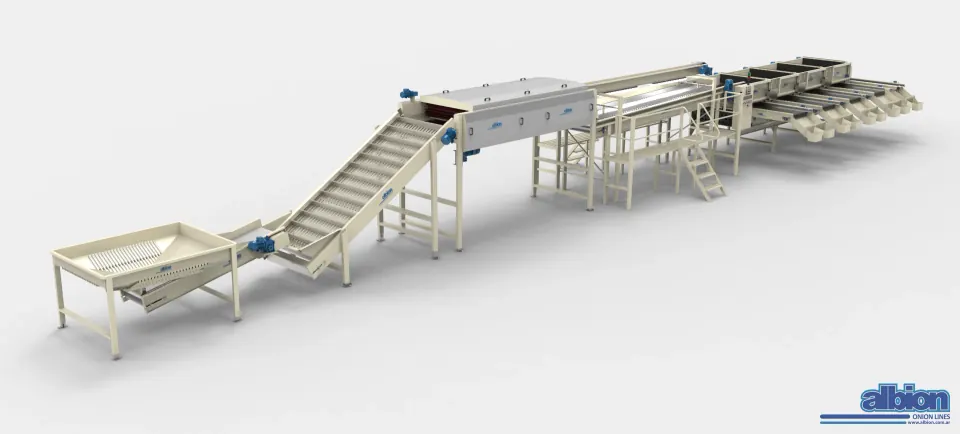
The LCC 6000 6T handles onion preparation with four modules in line. Each one has a specific job.
1. Receiving: hopper with conveyor
Onions enter in bulk through a receiving hopper with conveyor, which transfers them in controlled flow to brushing.
2. Brushing: cleaning and presentation
The brusher uses rotating brushes in gentle contact with the onion. They remove loose scales, dust, and pieces of skin detached during handling. The brushes are natural fiber with adjustable pressure, so they clean without damaging the bulb’s useful layers.
3. Inspection: the human check
On the inspection conveyor, operators remove split, sprouted, or rotten bulbs. Placing this stage before sizing is no small detail: defects leave the flow before they reach the sizer and, from there, the pack.
4. Sizing: six commercial sizes
The onion sizer closes the process and delivers product separated into 6 defined commercial sizes. That way, every sales format (net, bag, or tray) is filled with consistently sized onions.
What the LCC 6000 6T includes and who it’s for
| Spec | LCC 6000 6T |
|---|---|
| Line | Onion brushing and sizing |
| Capacity | 3,000 kg/h in continuous flow |
| Modules | Receiving hopper with conveyor, brusher, inspection conveyor, onion sizer |
| Output | 6 commercial sizes, ready for net, bag, or tray packaging |
It’s a mid-high capacity line, ideal for regional packers serving domestic retail and exporting part of their production. If your plant fits that profile, this is your starting point.
Beyond complete lines, Albion also manufactures standalone equipment (elevators, an inspection conveyor, and a hydraulic bin tipper, among others), which you can browse on our Equipment page. If your process needs more than the line’s four modules, get in touch.
How to size it: an orientative example
The basic calculation is simple:
Annual capacity = hourly capacity × hours per day × days per year
Let’s take a standard operation of 8 hours per day, 200 days per year as an orientative assumption:
- Per shift: 3,000 kg/h × 8 h = 24,000 kg, or 24 tons.
- Per year: 24 tons × 200 days = 4,800 tons.
Running the math in reverse tells you how many line hours you need. If, for example, your packing operation handles 1,200 tons a year, at 3,000 kg/h that’s 400 hours of work: about 50 eight-hour shifts.
Important: these figures are orientative and based on the line’s published capacity. To size your case, send us your data.
Net packaging with C-Pack
The LCC 6000 6T delivers onions ready for net, bag, or tray packaging. If your format is net bags (the presentation supermarkets demand for fresh produce), Albion represents C-Pack (Germany) in Argentina.
What you should know:
- C-Pack is not made by Albion. Its machines are manufactured by C-Pack GmbH, a German family-owned company with over 50 years in net-packaging machines, headquartered in Tornesch. Albion represents and distributes it in Argentina.
- Full catalog. The automatic net packers of the VAC (clip closure) and VAS (film band) series, and the semi-automatic HCL 912 and HS 913.
- Sectors: packing of fresh fruits, fresh vegetables, and horticultural products, a segment where product presentation and integrity are critical.
The right model depends on your scale and your sales format; contact us and we’ll review it together with the line. More details on the C-Pack page.
Warranty, pre-assembly, financing, and support
Albion is a family-owned company from Mendoza, Argentina, founded on April 20, 1966 by Atilio César Dal Pozzo. The second generation leads it today, with the third already joining, and it has more than 50 in-house experts. Here’s what comes with every line:
- 12-month warranty on mechanical parts of Albion’s own manufacture. It does not cover consumables or damage caused by improper maintenance.
- Workshop pre-assembly: lines ship pre-assembled from the workshop.
- Financing: many customers finance their investment through Banco Nación credit lines for domestic industrial machinery. You handle the application with the bank; Albion issues the necessary documentation.
- Support: after-sales technical support is concentrated in Latin America, but Albion ships equipment worldwide. Today it has equipment operating in 18 countries across 6 continents.
Next step
Your volume, your sales formats, and your market define the line. Here’s how to move forward:
- Send us your operation’s data: estimated annual volume, working hours and days, packaging formats (net, bag, or tray), and target market.
- Get a proposal: the line sized for your case, with a quote.
- Review financing options with Banco Nación credit lines, if applicable.
Visit our Onions page, see photos and components of the LCC 6000 6T, or contact us to start your quotation.
Frequently asked questions
- What exactly does the LCC 6000 6T line do?
- It brushes, inspects, and sizes onions in a continuous 3,000 kg/h flow. It has four modules: receiving hopper with conveyor, brusher, inspection conveyor, and onion sizer. At the output, onions are separated into 6 commercial sizes and ready for net, bag, or tray packaging.
- Can brushing damage the onions?
- The brusher uses rotating natural-fiber brushes in gentle contact with the bulb, and brush pressure is adjustable. The goal is to remove loose scales, dust, and handling-detached skin pieces without damaging the useful layers.
- What kind of packing operation is this line for?
- With its mid-high capacity, the LCC 6000 6T is ideal for regional packers serving domestic retail and exporting part of their production. It is designed to integrate upstream of standard baggers and tray-loaders.
- Does Albion also manufacture the net-packaging machines?
- No. C-Pack net-packaging machines are made by C-Pack GmbH, a German family-owned company headquartered in Tornesch. Albion represents and distributes its full catalog in Argentina. The brushing and sizing line, on the other hand, is manufactured by Albion.
- What does the line's warranty cover?
- Albion provides a 12-month warranty on mechanical parts of its own manufacture. It does not cover consumables or damage caused by improper maintenance. Lines also ship pre-assembled from the workshop.
- Can I buy the line if my plant is outside Argentina?
- Yes. Albion ships equipment worldwide and today has equipment operating in 18 countries across 6 continents. After-sales technical support is concentrated in Latin America, so it's worth discussing when you request your quote. The C-Pack representation, however, covers Argentina.
Lines mentioned in this article
Ready to size your processing line for onions?
Send us your operation's basic data and we'll prepare a proposal sized to your volume and your warehouse.
Request a quote