
Glossary of Industrial Dried Fruit, Nut and Vegetable Processing
What the processes and machines in Albion's lines mean: destemming, dehulling, cracking, sizing and screens, with the Spanish term for each.
Albion’s line pages name dozens of processes and machines. This glossary collects the main ones as they appear on the site, with the term used on the Spanish pages in parentheses and links to the lines where each one appears. It is organized by stage: processes, equipment by its position on the line, and parts of the product.
Processes
Washing (lavado): removes adhered soil and impurities with water, in rotary drums, cascades or flotation tanks (PUA 2000 L, ZC 8000, AV 10000).
Destemming (despalillado): separates raisins from the rachis and the pedicels. It is the core stage of the raisin D lines (PUA 300 D, PUB 2000 D).
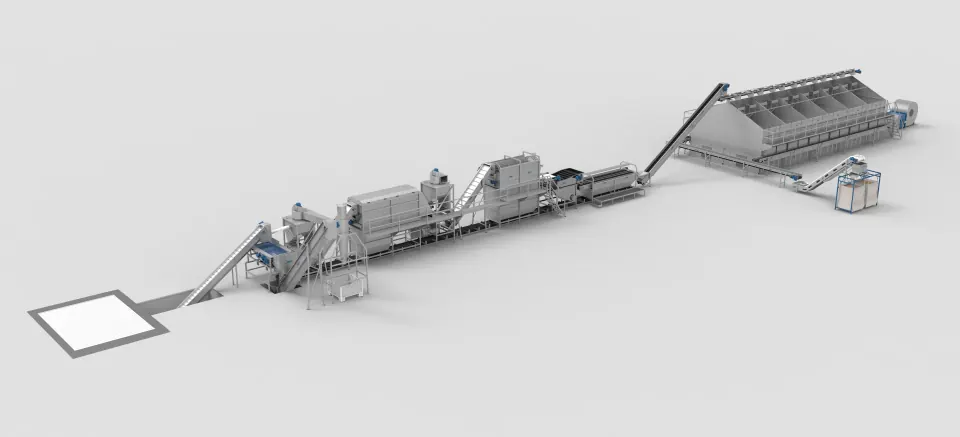
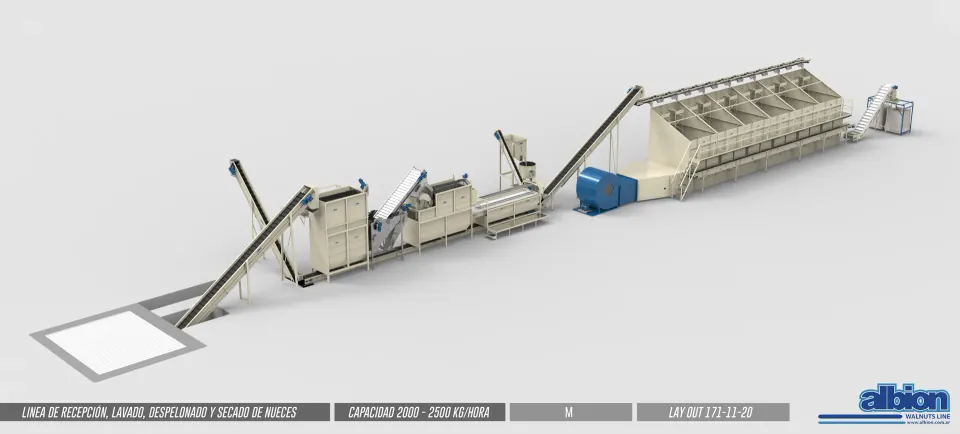
Dehulling (despelonado): removes the green husk walnuts carry when they come in from the field. On the Integral Line M, a Rotary Huller (huller rotativo) does it after washing, using a brush with steel bristles.
Cracking / Cutting (partido): Spanish uses one word for two jobs. For walnuts and almonds, cracking breaks the shell to release the kernel (AP 300, ALP 300); for dried tomatoes, cutting slices each tomato into three pieces (TO C 2800).
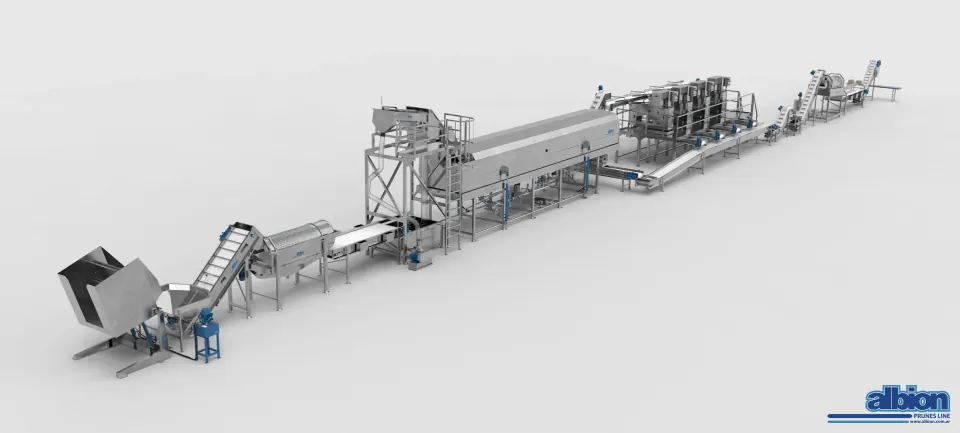
Pitting (descarozado): extracts the pit from the prune without damaging the pulp. It is the heart of the integral lines CD 4, CD 6 and CD 8, with 4, 6 or 8 pitters.
Tenderizing (tiernizado): conditions prunes before pitting. The Continuous Hydrator-Tenderizer (hidratador-tiernizador continuo) is a closed tunnel where the fruit takes on moisture and temperature from direct steam (CD 4).
Sizing (calibrado, tamañado): classifies product by size into commercial grades. There are prune sizing lines (CE 1200) and walnut sizing lines (CR 1000 6T), plus sizers inside raisin, almond, garlic, onion, potato and carrot lines. The Spanish pages use two words for it: tamañado in the garlic line titles (T 1200 CMZV 7T) and in the sizing screens (zaranda de tamañado) of the raisin destemming lines, and calibrado everywhere else, including the garlic sizer (calibradora de ajos).
Selection (selección): separates good product from shell, impurities and defects, using screens, aspiration and inspection (AP 300) or by hand (ASM 700). Most raisin destemming line titles speak of sorting (clasificación): classifying the clean raisins by size.
Brushing (cepillado): a Brusher (cepilladora) cleans the product surface with brushes. It removes loose scales and dust from onions (LCC 6000 6T) and adhered soil from potatoes (PC 4000).
Brightening (abrillantado): gives the fruit its final commercial appearance. On the raisin washing and finishing lines, the Elevator with Brightener (elevador con abrillantador) lifts the raisins with an auger while a dosing pump applies the oil (PUB 600 L); on prune lines, the Brightener (abrillantador) applies brightening agent and sorbate (CD 4).
Packing (empaque): the end of the line, where product is bagged, weighed or loaded, depending on the line. It appears in the titles of the PC 4000, the ZC 8000 and the TO dried tomato lines, which fill trays for drying.
Equipment
Reception, feeding and conveying
Hydraulic Bin Tipper (volcador de bins hidráulico): tips the bin at the start of the line without impact or free fall (CD 1200); it is also sold as individual equipment. The PUA 5000 D uses a Bin Tipper with Accumulator (volcador de bins con acumulador): three bins waiting and one in the tipper.
Reception Vat / Receiving Vat (lagar de recepción): takes direct field discharge, by truck or in bins, with buffer capacity (M, AV 10000).
Water-Flume Receiver with Elevator (receptor hídrico con elevador): receives tomatoes directly into water to avoid impacts (TO B 2800).
Dosing Feeder (alimentador dosificador): regulates intake so the line runs at a steady flow. On destemming lines it includes a Cluster Decompacter (desmenuzador de racimos) (PUB 600 D) or, on the PUA 5000 D, a Cluster Breaker (desracimador), which starts breaking up the clusters.
Elevator (elevador): carries product vertically between stages. The one sold as individual equipment uses a belt with adhered paddles; on the walnut sizing lines it is a Bucket Elevator (elevador de cangilones) (CR 800 5T).
Roller Loader (cargador a rodillos): separates clumped garlic heads and aligns them for sizing (T 900 CMZVC).
Cleaning and washing
Screen (zaranda): a sieve, usually vibrating, with mesh or perforated plate. Its name changes with the job, and on the raisin washing lines the English pages call it a vibrator.
Cleaning Screen (zaranda de limpieza): on the CD, CE and CF prune sizing lines it removes fines, loose pits and plant debris (CD 1200); on the ASM 700, small shell pieces from walnut kernel.
Separating Screen (zaranda separadora): after cracking, separates broken shell from kernel together with a vacuum aspirator (AP 300, ALP 300).
Vacuum Aspirator (aspirador por vacío): draws off stems, leaves, peduncles and light particles, with automatic waste discharge (PUB 600 D, CD 1200).
Mega Aspirator (mega aspirador): on cracking lines, removes almost all remaining shell and light particles (AP 700, ALP 700). The Mega Vac on the PUA 5000 D combines air flotation from below with suction from above.
Trommel (tromel): a perforated rotary drum. It separates loose raisins from clusters and stems (PUA 5000 D) and, for hazelnuts, performs a coarse size classification and removes stones and soil clumps (AV 10000).
Rotary Pre-cleaner (precleaner rotativo): a hexagonal rod cylinder that removes leaves, sticks and stones before washing (M).
Debrancher (desrramador): a vibrating sieve that separates branches, stalks and coarse plant matter from hazelnuts (AV 10000).
Rotary Washer (lavadora rotativa): a drum with water spray that removes adhered soil (ZC 8000). On the tomato lines it is the Rotary Drum Washer (lavadora a tambor rotativo) (TO C 2800).
Cascade Washer (lavadora por cascada): raisins enter a recirculating water bath that carries away impurities (PUA 300 L). The Double Cascade Washer (lavadora de cascada doble) has two water steps (PUA 2000 L).
Flotation Washer (lavadora por flotación): a tank where sound hazelnuts float and dense impurities settle (AV 10000).
Rinsing and Dewatering Vibrator (zaranda de enjuague y escurrido): rinses with a clean-water shower and recovers excess water through vibration (PUA 300 L).
Centrifuge (centrífuga): removes surface water from washed raisins without damaging them (PUB 600 L).
Destemming, cracking and pitting
Conical Destemmer (despalillador cónico): a conical refiner with inner rubber paddles and grooved rubber-lined walls, height-adjustable for the raisin type (PUA 300 D). The PUB 2000 D uses two in series, with an aspirator between them.
Mechanical Cracker (inverted cone) (partidora mecánica de cono invertido): its height-adjustable inner cone applies the right pressure for each walnut or almond size (AP 300, ALP 300). The 700 versions use a Set of Mechanical Crackers (conjunto de partidoras mecánicas) in parallel.
Pitter (descarozadora): a step-by-step head adjustable to any prune size, with knives that extract the pit through the natural opening. Pits leave on a Pit Extraction Conveyor (cinta de extracción de carozos) (CD 6).
Three-Way Tomato Cutter (partidora de tomates de tres vías): parallel blades cut each tomato into three uniform pieces (TO B 2800).
Metabisulfite Application Tank with Elevator (cuba para aplicación de metabisulfito con elevador): applies metabisulfite to the cut tomatoes, a preservative authorized for drying that protects color and shelf life (TO C 2800).
Sizing
7-, 9-, 13- or 15-Caliber Sizer (calibradora de 7, 9, 13 o 15 calibres): the prune sizer, with a vibrating screen and interchangeable perforated plates whose hole diameters the customer chooses (CA 1000 7T, CE-E 1200). Its working width (ancho útil) ranges from 1000 to 1800 mm.
Automatic Mobile Cart (carro móvil automático): rubber paddles that travel over the prune sizer so the fruit doesn’t stick to the plates (CA 1200).
Rotary Cylinder Sizer (calibradora de cilindro rotativo): a perforated cylinder that classifies in-shell walnuts into 5 or 6 sizes, with lateral outlets for bags (CR 800 5T). The BC version discharges centrally, straight into bins (CR 1000 6T BC).
Sizing Screen (zaranda de tamañado): classifies clean raisins into commercial sizes; on the PUB 600 D, into 3. On the PUA 300 D it sits below the destemmer to save space.
Quarters and Pieces Separator (separador de cuarto y cuartillo): classifies clean walnut kernel by size (AP 300). On the AP 700, a Kernel Separating Screen (zaranda separadora de pulpa) splits it into butterflies, quarters and pieces.
Garlic, Potato and Onion Sizers (calibradoras de ajos, papas y cebollas): the garlic sizer delivers 5+1 or 6+1 sizes (T 900 CMZVC); the potato sizer, 3 sizes + 1 reject fraction (PC 4000); the onion sizer, 6 sizes (LCC 6000 6T).
Roller Sizer (calibradora a rodillos): carrots travel along rollers with progressively wider spacing and drop by gravity when the gap matches their size (ZCR).
Inspection and selection
Inspection Conveyor (cinta de inspección): a belt where operators remove defects by hand. There are lines with an inspection conveyor for all ten products. The one sold as individual equipment has adjustable speed, dedicated lighting, side bins for non-conforming product and room for several operators working in parallel.
Illuminated Inspection Belt (cinta de inspección con luminaria): adds high-intensity lights for uniform visibility (PUA 300 L).
Spacing Vibrator (zaranda espaciadora): spreads raisins evenly across the belt width and prevents clusters that hinder inspection (PUA 2000 L).
Waste Elevator (elevador de residuos): lifts rejects from inspection for dispatch outside the line (AV 10000, M).
Metal Detector (detector de metales): a final sanitary check at the output of the CD 6 and CD 8, against metal contamination.
Finishing, weighing and packing
Automatic Weighing (pesado automático): a load cell weighs product in exact batches, programmed from a touch screen (PUB 600 L).
Weigher (pesadora): checks the weight of each bag before closing (PC 4000). The PES 25 Weigher Bagger for Nuts (pesadora embolsadora para frutos secos) is individual equipment for 10 to 25 kg sacks.
Roller Table with Tray Filler (transportín a rodillos con llenador de bandejas): loads each tray with the right amount of tomato for drying (TO B 2800).
Oven Module with Platform (módulo de horno con tarima): an individual oven with an elevated platform for inspection and maintenance; a Burner (quemador) supplies the heat. The plant can add modules as it grows (M).
Big-Bag Filling System (sistema de llenado de big bags): dried walnuts fall straight into the big bag, with no intermediate handling (M).
Product terms
Husk (pelón): the green covering of freshly harvested walnuts. The capacity of the M is measured in walnut with husk (nuez con pelón).
Kernel (pulpa): what remains of a walnut or almond once the shell is removed. Cracking lines state capacity in calibrated in-shell walnut or almond (nuez o almendra con cáscara calibrada), which is what enters the line; the cracking cone is adjusted for each size (AP 700).
Butterfly, Quarter and Piece (mariposa, cuarto, cuartillo): walnut kernel categories, separated by size. The butterfly is the whole half, the highest-value kernel; then come the quarter and the piece (cuartillo), the smallest fragments. Cracking lines are designed to keep the butterfly as whole as possible.
Rachis and Pedicel (raspón, pedicelo): the rachis is the main stem of the cluster, and the pedicel is the small stem that attaches each grape to it. Destemming separates both from the raisin.
Scale (catáfila): a dry outer layer of onion or garlic. For garlic, the pre-cleaning screen separates detached scales (T 900 CMZVC); for onions, the brusher removes loose ones (LCC 6000 6T).
Size (calibre): each size category. For prunes and walnuts, the total adds up lateral outlets plus one end outlet: the CA 1000 7T gives 7 sizes (6 lateral + 1 end) and the CR 1000 6T, 6 (5 + 1). On the T 900 CMZVC (5+1) and the PC 4000 (3+1), by contrast, the +1 is the reject fraction (fracción de descarte).
Next step
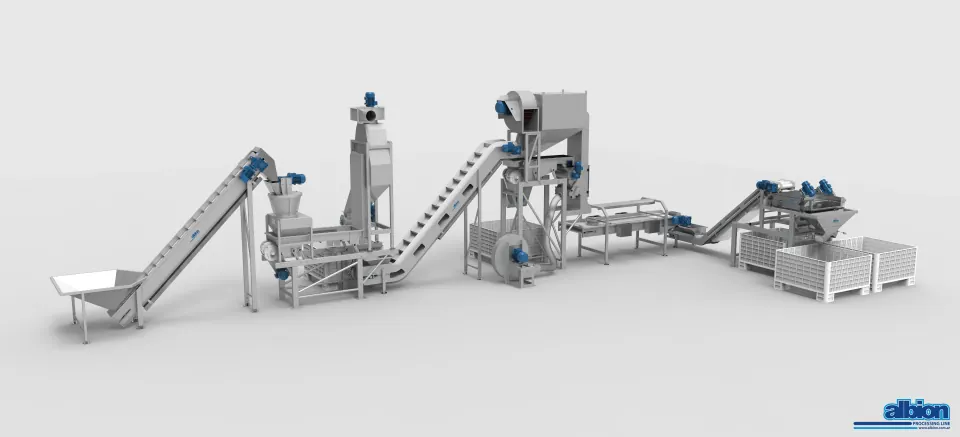
To see how this equipment fits together for each product, read our guides for raisins, prunes, walnuts, almonds, hazelnuts, dried tomatoes, carrots, garlic, onions and potatoes. If you’d like us to recommend a configuration, contact us.
Frequently asked questions
- Why does Albion's Spanish site use both calibrado and tamañado for sizing?
- They mean the same thing: classifying product by size into commercial grades. Tamañado appears in the garlic line titles and in the sizing screens of the raisin destemming lines; calibrado is used on the other lines and inside those same lines too, as in the garlic sizer (calibradora de ajos). The English line pages translate both as sizing.
- What does dehulling a walnut mean?
- Dehulling removes the green husk walnuts carry when they come in from the field. On the Integral Line M, a rotation washer softens the husk and a rotary huller then removes it with a rotary brush with steel bristles. The walnuts then go through inspection, oven drying and big-bag filling. In Spanish, the process is called despelonado.
- What's the difference between destemming and pitting?
- Destemming separates raisins from the rachis and the pedicels; on the PUA 300 D, PUB 600 D and PUB 2000 D it uses a height-adjustable conical destemmer with inner rubber paddles and grooved rubber-lined walls. Pitting removes the pit from the prune: on the integral pitting lines CD 4, CD 6 and CD 8, each pitter has a step-by-step head adjustable to fruit size and knives that extract the pit through the natural opening without damaging the pulp.
- Why is partido translated as cracking for nuts but cutting for tomatoes?
- Because the job is different. For walnuts and almonds, partido means breaking the shell to release the kernel with an inverted-cone mechanical cracker, so the English term is cracking. For dried tomatoes, the three-way cutter slices each tomato into three pieces with parallel blades before metabisulfite application, so the English term is cutting.
- What is a screen (zaranda), and why does it have so many names?
- It is a sieve, usually vibrating, with mesh or perforated plate. Its name changes with the job it does on the line: cleaning, separating, sizing, rinsing and dewatering, or spacing. On the raisin washing lines, the English pages call it a vibrator rather than a screen.
Lines mentioned in this article
Ready to size your processing line?
Send us your operation's basic data and we'll prepare a proposal sized to your volume and your warehouse.
Request a quote