
Individual Equipment or a Complete Line? How to Decide What to Buy
Complete line or standalone equipment? Albion's individual equipment by function, when each path makes sense and how to order spare parts.
When you plan a machinery investment, the first decision isn’t the model: it’s how much of the process you want to cover. Albion sells two ways: complete lines, designed for one product and one part of its process, and individual equipment by function, which you can integrate into a line you already have or buy as a standalone unit.
This guide walks through the individual equipment catalog, when each path makes sense and how to handle spare parts once your plant is running.
Two ways to buy from Albion
A complete line
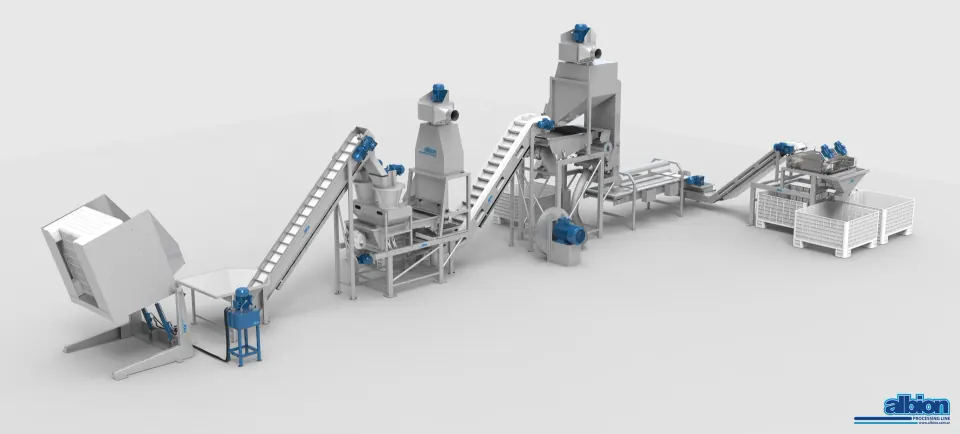
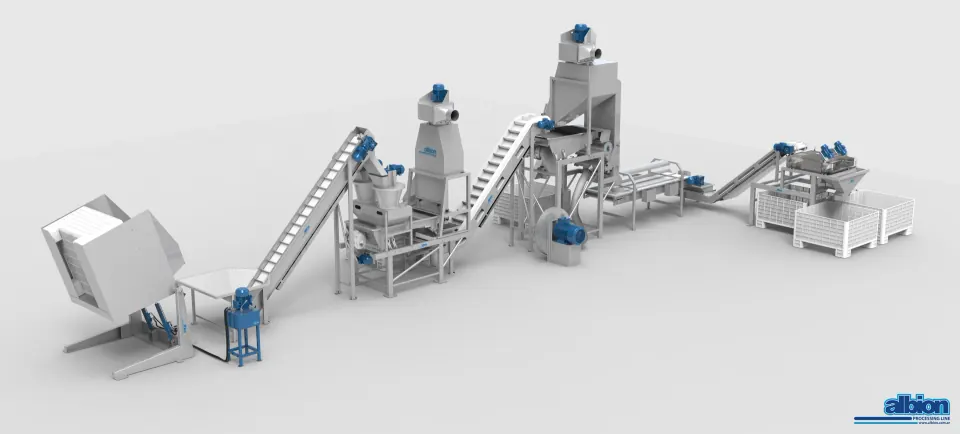
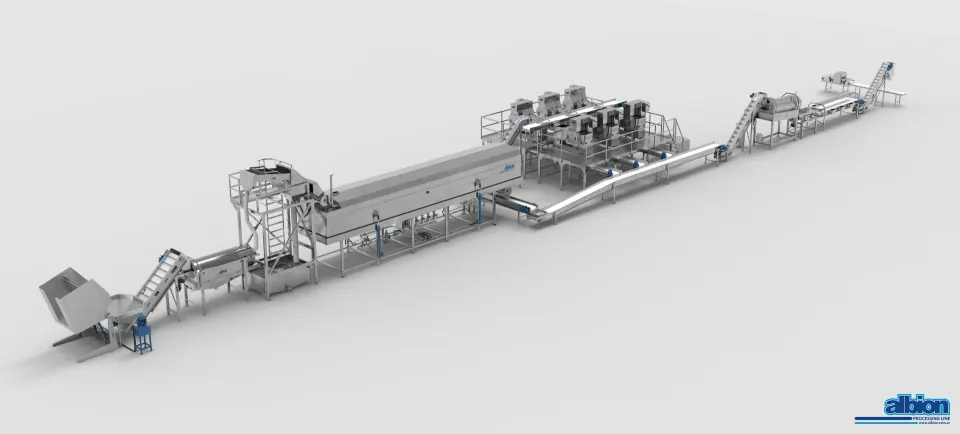
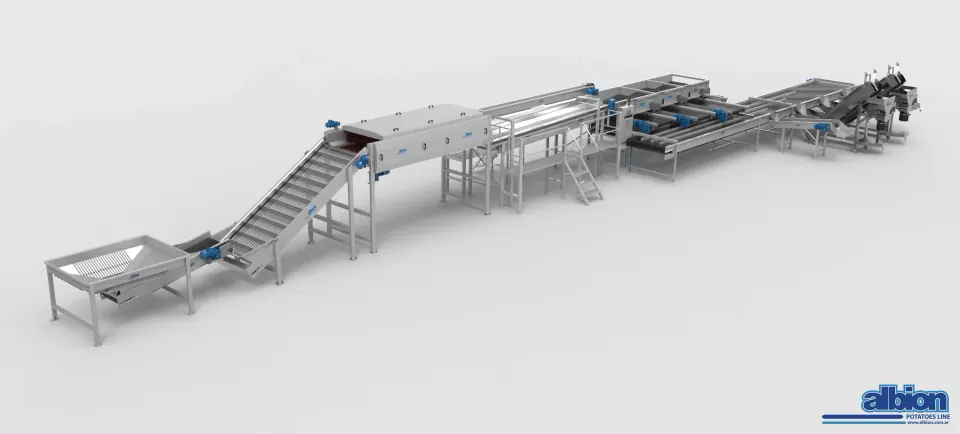
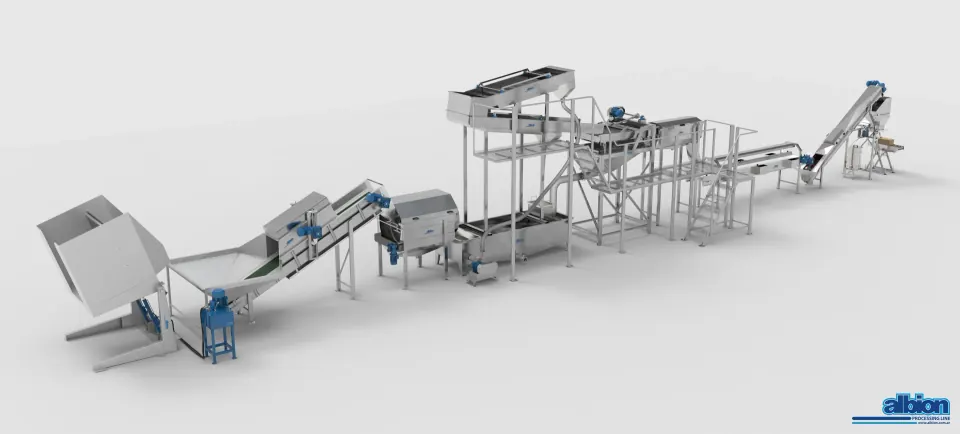
Albion designs and builds complete lines for ten products: raisins, prunes, walnuts, almonds, hazelnuts, dried tomatoes, carrots, garlic, onions and potatoes. Each line covers one part of that product’s process (washing, dehulling, sizing, cracking, pitting, destemming, sorting, brushing or packing, depending on the model) with the machines already chained together. The walnut AP 700, for example, starts with a hydraulic bin tipper and continues with elevators, crackers, screens, aspirators, an inspection conveyor and final kernel classification.
Every line is pre-assembled and concatenated in our workshop before dispatch, so it arrives ready to assemble on-site.
Individual equipment
Beyond its lines, Albion offers components and modules by function, available both to integrate into existing lines and as standalone units. These are functions that also appear inside many lines (tipping bins, elevating product, inspecting, weighing and bagging), offered as separate machines.
The individual equipment catalog
The equipment page currently groups six machines into four functions: bin tippers, elevators, inspection conveyors and weigher-baggers.
| Equipment | Model | What it does | Products |
|---|---|---|---|
| Bin Tipper | VB 500 | Hydraulic bin tipper for the start of the line, with an independent hydraulic power unit (three-phase motor, pump and cylinders). Tips product without impact or free fall | — |
| Elevator | — | Vertical transport with a paddle belt, drive and tension rollers on self-aligning bearings. Modular construction in stainless steel or painted, depending on the line module it integrates with | Walnut, raisin, prune and other products |
| Elevator (two variants) | — | Process-line variants, with configuration adapted to the throughput and product type of the module they’re installed on | — |
| Inspection Conveyor | — | Visual quality control with adjustable speed and dedicated lighting. Side bins for non-conforming product and a working width sized for several operators in parallel | — |
| Weigher Bagger for Nuts | PES 25 | Programmable electronic weigher-bagger for 10 to 25 kg sacks | Nuts |
Two details worth knowing before you request a quote:
- VB 500: it’s compatible with standard 1,000×1,200 and 1,200×1,200 bins.
- PES 25: two loading conveyors with PVC belts and paddles, each driven by its own geared motor, and a weighing system with two load cells. From the touch screen you set cut and pre-cut weights, store package presets and switch between automatic and semi-automatic mode.
The same functions, inside the lines
These functions are part of many Albion lines. A few examples, based on each line’s component list:
| Line | Product | Catalog functions among its components |
|---|---|---|
| AP 700 | Walnuts | Hydraulic bin tipper, elevators and inspection conveyor |
| ALP 700 | Almonds | Hydraulic bin tipper, elevators and inspection conveyor |
| CD 6 | Prunes | Hydraulic bin tipper, elevators, inspection conveyors and a weighing elevator |
| PUB 600 L | Raisins | Hydraulic bin tipper, illuminated inspection belt, elevator with brightener and automatic weighing |
| PC 4000 | Potatoes | Elevator, inspection conveyor and weigher |
So the real question isn’t which machine is better, but how much of the process you already have covered.
When an individual machine makes sense
- You already have a line and it’s missing a function. The individual equipment is also offered for integration into existing lines. If you need to tip bins at the start of the line, the VB 500 does it without impact or free fall; if you want a visual control station, the inspection conveyor adds adjustable speed, dedicated lighting and room for several operators.
- You want to mechanize a single stage. That’s the logic behind the ZCR for carrots, which Albion offers as a standalone unit: if your plant already has washing and packing but sizing is done by hand, it’s the incremental investment that automates that bottleneck.
- You need to close the process with bagging. The PES 25 weighs and bags nuts into 10 to 25 kg sacks, in automatic or semi-automatic mode.
- You need to move product between modules. Elevators are built in stainless steel or painted depending on the module they integrate with, and their variants adapt the configuration to throughput and product type.
To quote a standalone machine, the key information is where it will work: what product, what volume and which module it will be installed on.
When a complete line makes sense
- You’re mechanizing an entire stage of the process. A line chains its machines in continuous flow. On the walnut AP 300, for example, that automates a complex process and reduces labor.
- You need the stages to run in balance. Lines are designed as a whole. The AP 700, for example, is designed to integrate with the CR 1000 6T or the CR VC 2000 6T, keeping the flow between sizing and cracking balanced.
- You want to receive the whole set already built. The line is pre-assembled and concatenated in our workshop before dispatch and arrives ready to assemble on-site.
The middle path
A complete line doesn’t force you to duplicate what you already own. The AP 700 without bin tipper is the version designed for plants that already have their own tipping or direct-discharge system, such as a silo, an elevated hopper or their own conveyor: it starts with an elevator that receives that flow and keeps the capacity of 600–650 kg/h of calibrated in-shell walnut. And the walnut Integral Line M has modular ovens: the plant starts with the number of modules its volume requires and can grow without replacing the line.
If you’re still not sure which stage to start with, the product guides walk through each process step by step (they’re linked at the end).
Spare parts: a catalog with codes
Albion keeps active inventory of spare parts for its lines and lists them in the spare parts catalog, which currently includes 76 parts, each with its code. Here’s how it works:
- Search by code or name.
- Choose a quantity and add the part to a quote cart.
- Send the request from the cart, and we’ll quote the parts you selected.
Among other items, the catalog includes PVC belts, modular belt modules with paddles, sprockets, eccentrics and connecting rods, rubbers and paddles for destemmers, pitting rubbers, cracker cones, centrifugal pumps, wheels and bearings.
Warranty and backing
Albion is a Mendoza company founded on April 20, 1966, by Atilio César Dal Pozzo. Today it’s led by the second generation, with the third already joining, and it has more than 50 in-house experts.
- 12-month warranty on mechanical parts of Albion’s own manufacture. It doesn’t cover consumables or damage caused by improper maintenance.
- Financing: many customers finance their investment through Argentina’s Banco Nación credit lines for domestic industrial machinery. You handle the application with the bank; Albion issues the documentation.
- Support: Albion equipment operates in 18 countries on 6 continents. After-sales technical support is concentrated in Latin America, but equipment ships to any market in the world.
Next step
- Browse the catalog on the Equipment page. Each machine has an Inquire button that opens its quote form, with the function and model already filled in. For example: VB 500 bin tipper, inspection conveyor or PES 25 weigher-bagger.
- In your message, tell us what product you process, what volume you handle (kg/h or t/day), whether the machine will be integrated into an existing line or work as standalone equipment, and how many units you’d need.
- If you’re evaluating a complete line, start with the guide for your product: raisins, prunes, walnuts, almonds, hazelnuts, dried tomatoes, carrots, garlic, onions or potatoes.
If you’d rather talk it through, contact us and we’ll help you decide what to buy.
Frequently asked questions
- Does Albion sell standalone equipment, or only complete lines?
- Both. Albion designs and builds complete lines for ten products, and it also offers equipment by function, available both to integrate into existing lines and as standalone units. Today that catalog includes the VB 500 bin tipper, elevators, the inspection conveyor and the PES 25 weigher-bagger.
- Can I add an Albion machine to a line I already have?
- Yes: the individual equipment is offered both for integration into existing lines and as standalone units. The elevator, for example, is built in stainless steel or painted depending on the line module it integrates with, and its variants adapt their configuration to the throughput and product type of the module they're installed on. That's why, when you request a quote, you should tell us what product you process, what volume you handle and where the machine will work.
- What bins does the VB 500 bin tipper accept?
- It's compatible with standard 1,000×1,200 and 1,200×1,200 bins. It's a hydraulic bin tipper for the start of the line, with an independent hydraulic power unit (three-phase motor, pump and cylinders), and it tips product without impact or free fall.
- What does the PES 25 weigher-bagger do?
- It weighs and bags nuts into 10 to 25 kg sacks. It has two loading conveyors, a weighing system with two load cells and a touch-screen control panel for setting cut and pre-cut weights, storing package presets, switching between automatic and semi-automatic mode, and calibrating the unit. Hopper unloading is electro-pneumatic, and bag discharge can be automatic or manual.
- When does a complete line make more sense than standalone machines?
- When you're mechanizing an entire stage of a product's process or equipping a new plant. A line chains its machines in continuous flow, is pre-assembled and concatenated in our workshop before dispatch, and arrives ready to assemble on-site. If part of your process is already in place, some versions adapt to it: the AP 700 without bin tipper starts with an elevator that receives flow from your own loading system.
- How do I order spare parts for my line or machine?
- Through the spare parts catalog on our website: you search by code or name, choose a quantity and add each part to a quote cart. Then you send the request from the cart and we quote the parts you selected. The catalog currently lists 76 parts, each with its code.
Lines mentioned in this article
Ready to size your processing line?
Send us your operation's basic data and we'll prepare a proposal sized to your volume and your warehouse.
Request a quote