
Size Grading for Dried Fruit, Nuts and Vegetables: How Each Line Does It
Which Albion lines size-grade raisins, prunes, walnuts, almonds, garlic, onions, potatoes and carrots: sizes, sizers and line stages.
Size grading means separating product by size into commercial fractions; across Albion’s lines it is also called sizing. The machine changes from product to product, but the questions stay the same: how many sizes you need, what happens before the sizer, and where each size goes afterward. This guide goes product by product: which lines grade by size, into how many sizes when the model defines it, and which machine does the work.
Why size-grade?
The line specifications give three reasons:
- Commercial sizes. Each size is a different sales option. The prune sizers range from 7 to 15 sizes, and the specs put it simply: more sizes, more differentiated price points per kilogram.
- Uniform product for packing. A uniform batch is easier to pack and sell. For fresh potatoes, onions and carrots headed to the supermarket, sizing is part of what is required before packing in bags, nets or trays.
- Preparation for the next process. For walnuts, sizing prepares cracking: well-sized walnuts reduce kernel breakage and increase halves recovery.
What comes before matters too: on the prune lines, cleaning upstream preserves sizing accuracy, and on the onion, potato and carrot lines, operators remove defective product on an inspection conveyor before sizing.
Product by product
Raisins
For raisins, size grading is part of the destemming lines (D), after destemming and aspiration. The washing and finishing lines (L) do not size-grade.
- PUA 300 D (250–300 kg/h): the Vibrating Sizing Screen sits below the conical destemmer and the aspirator, using gravity and saving floor space. It classifies the raisins into commercial sizes.
- PUB 600 D (550–600 kg/h): the Sizing Screen (3 sizes) delivers the raisins in three commercial sizes, ready for washing or packing.
- PUB 2000 D (1,800–1,900 kg/h): with two conical destemmers in series, it ends in a Sizing Screen that classifies the raisins into distinct commercial categories.
- PUA 5000 D (3,000–3,500 kg/h): the Size Grader has two interchangeable screens that release quickly, with perforations chosen by the customer, and cross conveyors that discharge each fraction separately. After sizing, an elevator takes the raisins to a screen and the Mega Vac for final cleaning.
Prunes
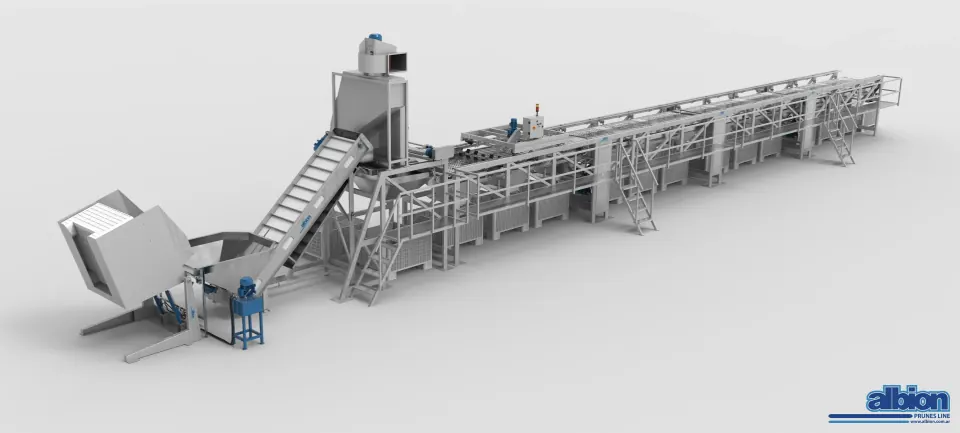
Prunes have the most sizing lines: fourteen. All of them end in an N-Caliber Sizer with interchangeable perforated plates (on most models, with hole diameters chosen by the customer) and an Automatic Mobile Cart, whose rubber paddles keep the sizing surface clean. Between models, what changes is the number of sizes and what comes first:
| Lines | Sizes | Before the sizer |
|---|---|---|
| CA 1000 7T, CA 1200 | 7 | An elevator only: for fruit that arrives already clean |
| CA-E 1000 | 9 | An elevator only |
| CD 1200, CD 1500 | 7 | Bin tipper, elevator, cleaning screen and vacuum aspirator |
| CE 1200, CE 1500, CE 1800 | 13 | Same as the CD lines |
| CE-E 1200, CE-E 1500, CE-E 1800 | 15 | Same as the CD lines |
| CF 1200, CF 1500, CF 1800 | 13 | Same as the CD lines, plus an inspection conveyor |
The pitting lines (CD 4, CD 6 and CD 8) do not include a sizer: their pitters have a head that adjusts to any prune size.
Walnuts
Walnuts go through sizing at two points: in-shell and, after cracking, as kernel.
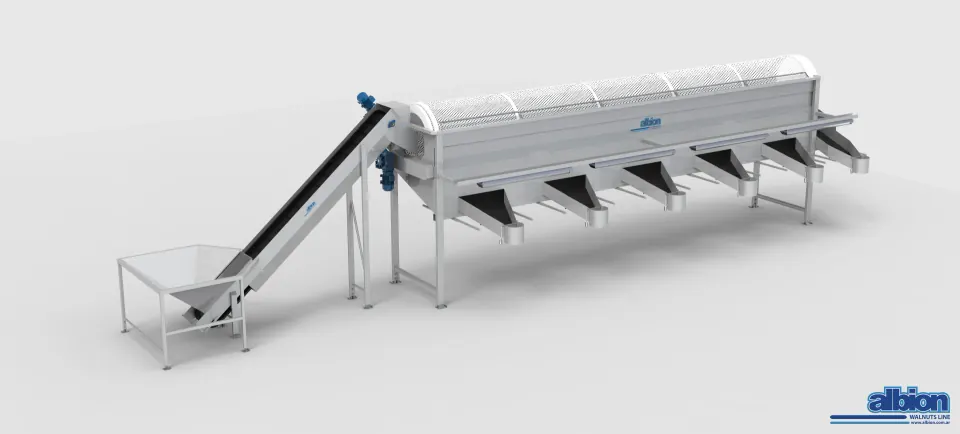
In-shell, the CR family: hydraulic bin tipper, bucket elevator and a perforated rotary cylinder sizer. The suffix gives the number of sizes: 5T sorts into five and 6T into six (5 lateral + 1 at the end).
- CR 800 5T (450 kg/h) and CR 800 6T (600 kg/h): Rotary Cylinder Sizer Ø800.
- CR 1000 5T, CR 1000 6T and CR 1000 6T BC (900–1,000 kg/h): Rotary Cylinder Sizer Ø950.
- CR VC 2000 6T (1,800–1,900 kg/h): Multiple Ø1000 Rotary Drum Sizers (6 sizes), working in parallel.
The CR 800 and CR 1000 lines discharge through lateral outlets for bag filling; the CR 1000 6T BC instead routes each size to central bins.
Kernel, the AP lines: after the inspection conveyor, an elevator carries the kernel to the machine that classifies it by size: the Quarters and Pieces Separator on the AP 300, and the Kernel Separating Screen (butterflies, quarters and pieces) on the AP 700 and the AP 700 without bin tipper. The screens are vibrating and chosen not to damage the kernel: the goal is to keep the butterfly as whole as possible.
Almonds
For almonds, what gets sized on the line is the kernel. After the inspection conveyor, the ALP 300 ends in a Sizer that separates whole kernels from broken kernels; the ALP 700 uses a Kernel Separating Screen (whole and broken). Capacity on both is measured in calibrated in-shell almond: if yours doesn’t arrive calibrated, let us know when you get in touch.
Garlic
All three garlic sizing lines start with a bin tipper and a pre-cleaning screen, then pass through a roller loader before the sizer.
- T 900 CMZVC (2,000–2,500 kg/h): adds a brusher; its roller loader separates clumped heads and aligns them for sizing, and the line ends in the Garlic Sizer – 5+1 Sizes: 5 commercial sizes and 1 reject fraction.
- T 1200 CMZV 7T (3,500–4,000 kg/h): Garlic Sizer – 6+1 Sizes, with a larger cross-section.
- T 1200 CMZIV 7T (3,500–4,000 kg/h): also a Garlic Sizer – 6+1 Sizes, with an industrial cross-section, and the loader integrated into an illuminated inspection conveyor.
Onions
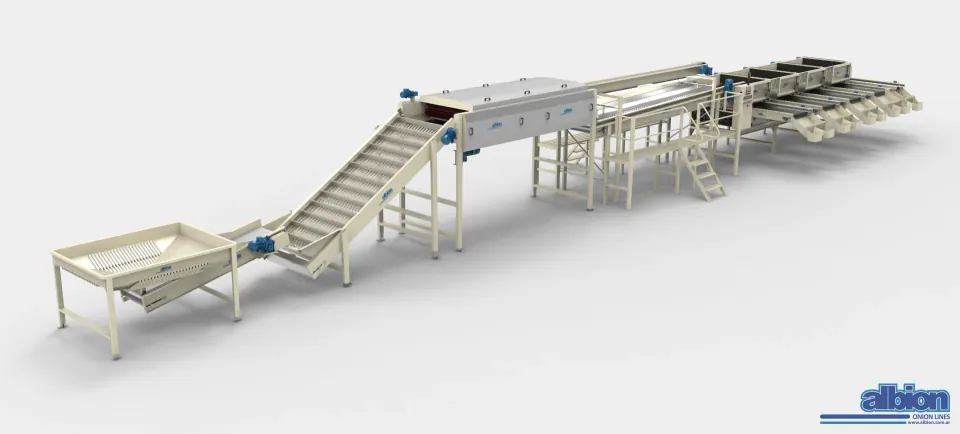
The LCC 6000 6T (3,000 kg/h) brushes the onions and runs them over an inspection conveyor, where operators remove split, sprouted or rotten bulbs. At the end, the Onion Sizer separates them into 6 defined commercial sizes, ready for net, bag or tray packing.
Potatoes
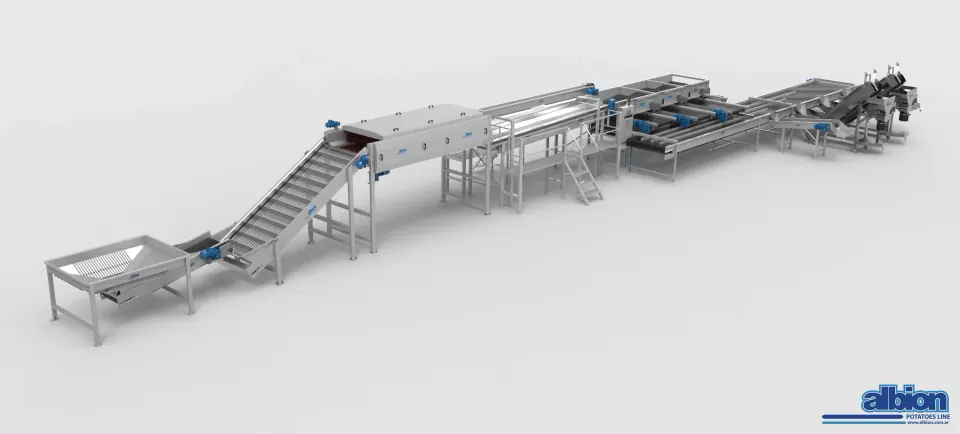
On the PC 4000 (4,000 kg/h), potatoes go through a receiving hopper, elevator, brusher and inspection conveyor before the Potato Sizer – 3+1 Sizes: 3 sizes and 1 reject fraction. A distribution conveyor then routes each size to its packing station, and the line closes with the conveyor with bagging hopper and the weigher.
Carrots
On the ZC 8000 (6,000–8,000 kg/h), after washing, a roller discard unit drops out-of-size carrots and broken pieces, and operators remove roots with serious defects on the inspection conveyor. An accumulation disc keeps the sizing rate steady, and the Sizer separates carrots by size according to the defined commercial matrix.
The hazelnut and dried tomato lines do not include a sizer. On the AV 10000, the trommel performs a coarse size classification before washing and removes stones and soil clumps.
Summary table
| Product | Line(s) | Number of sizes | Sizing machine |
|---|---|---|---|
| Raisins | PUA 300 D | several commercial sizes | Vibrating Sizing Screen |
| Raisins | PUB 600 D | 3 | Sizing Screen (3 sizes) |
| Raisins | PUB 2000 D | distinct commercial categories | Sizing Screen |
| Raisins | PUA 5000 D | depends on the screens chosen | Size Grader |
| Prunes | CA 1000 7T, CA 1200, CD 1200, CD 1500 | 7 | 7-Caliber Sizer |
| Prunes | CA-E 1000 | 9 | 9-Caliber Sizer |
| Prunes | CE 1200, CE 1500, CE 1800, CF 1200, CF 1500, CF 1800 | 13 | 13-Caliber Sizer |
| Prunes | CE-E 1200, CE-E 1500, CE-E 1800 | 15 | 15-Caliber Sizer |
| In-shell walnuts | CR 800 5T and 6T, CR 1000 5T, 6T and 6T BC | 5 (5T) or 6 (6T) | Rotary Cylinder Sizer Ø800 or Ø950 |
| In-shell walnuts | CR VC 2000 6T | 6 | Multiple Ø1000 Rotary Drum Sizers |
| Walnut kernel | AP 300 | several commercial categories | Quarters and Pieces Separator |
| Walnut kernel | AP 700, AP 700 without bin tipper | butterflies, quarters and pieces | Kernel Separating Screen (butterflies, quarters and pieces) |
| Almond kernel | ALP 300 | whole and broken kernels | Sizer |
| Almond kernel | ALP 700 | whole and broken | Kernel Separating Screen (whole and broken) |
| Garlic | T 900 CMZVC | 5+1 | Garlic Sizer – 5+1 Sizes |
| Garlic | T 1200 CMZV 7T, T 1200 CMZIV 7T | 6+1 | Garlic Sizer – 6+1 Sizes |
| Onions | LCC 6000 6T | 6 | Onion Sizer |
| Potatoes | PC 4000 | 3+1 | Potato Sizer – 3+1 Sizes |
| Carrots | ZC 8000 | per the commercial matrix | Sizer |
| Carrots | ZCR | multiple output lanes | ZCR Mechanical Roller Sizer |
Is the sizer available as a standalone machine?
Albion’s individual equipment (the VB 500 bin tipper, elevators, inspection conveyor and PES 25 weigher bagger) does not include a sizer: sizing comes built into the lines. The exception is carrots. The ZCR is a mechanical roller sizer offered as a standalone unit, to add to the washing and packing line you already have: carrots travel along rollers with progressively increasing spacing and drop by gravity when the gap between rollers matches their size. Its capacity is defined by how it integrates with your line.
For other products, if you only need the sizing stage, the shortest configurations are the CA prune lines (elevator, sizer and mobile cart) and the CR walnut lines (bin tipper, elevator and sizer).
Next step
To recommend a sizer, tell us:
- Which product you grade and what condition it arrives in: clean or carrying soil and debris, pre-sorted or straight from harvest.
- How many sizes your buyers ask for.
- What volume you process per season and how you pack each size: bags, bins, nets or trays.
Each product has its own guide covering all of its lines: raisins, prunes, walnuts, almonds, garlic, onions, potatoes and carrots. With those details in hand, reach us through the contact page to start your quote.
Frequently asked questions
- How many sizes can an Albion line grade into?
- It depends on the product and the model. For prunes, the sizers deliver 7, 9, 13 or 15 sizes, and for in-shell walnuts, 5 or 6. Garlic lines deliver 5+1 or 6+1 sizes, the onion line 6 commercial sizes, and the potato line 3 sizes plus 1 reject fraction. For raisins, the PUB 600 D grades into 3 sizes.
- Can I choose which sizes I get?
- On the prune lines, the sizer uses interchangeable perforated plates, and on most models the hole diameters are the customer's choice. On the PUA 5000 D raisin line, the size grader has two quick-release interchangeable screens with perforations chosen by the customer. On the ZC 8000 carrot line, the sizer separates by size according to the defined commercial matrix.
- Why size walnuts before cracking them?
- Because well-sized walnuts reduce kernel breakage and increase halves recovery, and halves are the highest-value product. The capacity of the AP cracking lines is also stated in calibrated in-shell walnut. The AP 700 is designed to integrate with the CR 1000 6T or the CR VC 2000 6T, keeping the flow between sizing and cracking balanced.
- What should go before the sizer?
- Clean product and, where needed, inspected product. On the prune lines, the CD, CE and CE-E models add a cleaning screen and a vacuum aspirator so the sizer always receives clean fruit, which preserves sizing accuracy. The CF models also add an inspection conveyor before sizing, as do the onion, potato and carrot lines.
- Does Albion sell the sizer as a standalone machine?
- For carrots, yes: the ZCR is a mechanical roller sizer offered as a standalone unit, to integrate with your existing washing and packing line. For the other products, sizing comes built into the lines. If you only need the sizing stage, the shortest configurations are the CA prune lines and the CR walnut lines.
- What does 5+1 or 3+1 sizes mean?
- It means the sizer delivers one more fraction on top of the commercial sizes. On the T 900 CMZVC garlic line, that is 5 sizes plus 1 reject fraction, and on the PC 4000 potato line, 3 sizes plus 1 reject fraction.
- How does each size leave the line?
- It depends on the line. The CR 800 and CR 1000 walnut sizers discharge through lateral outlets for bag filling, except the CR 1000 6T BC, which routes each size to central bins. Most prune sizers discharge through pyramidal hoppers with guillotine-type gates. On the potato and carrot lines, a distribution conveyor routes each size to its packing station.
Lines mentioned in this article
Ready to size your processing line?
Send us your operation's basic data and we'll prepare a proposal sized to your volume and your warehouse.
Request a quote